
Venerable St Kevin of Glendalough, the Wonderworker
Updated: Aug 31

St. Kevin (Modern Irish: Caoimhín; Old Irish: Cóemgen, Caemgen; Latinized Coemgenus; 498 (reputedly)-3 June 618) is one of Ireland's most revered saints and founded the famed and historic Glendalough Monastery. He lived throughout the sixth and early seventh centuries. His life was immortalised approximately four hundred years after his death. The future saint was born in the Irish province of Leinster to an aristocratic family with royal ties. According to the most frequent explanation, his name means "of blessed birth".
It is stated that just before Kevin's baptism, an angel appeared to his parents and instructed them to give him this name. It is also reported that Kevin's mother experienced no labour pangs when giving birth to him.
St. Cronan of Roscrea baptised Kevin, and as a youngster, he was raised by St. Petroc of Cornwall, who lived in Ireland. At the age of twelve, the young boy was already living with monks. When he was training to become a priest, his tutor was his holy relative, Eoghan, or Eugene of Ardstraw.

After being ordained to the clergy, St Kevin travelled through the Wicklow Mountains with the company of an angel and settled at the upper lake at Glendalough, which means "the glen of two lakes" since
it contains two lakes, upper and lower, that are near together. Before constructing his major monastery, the saint lived in utter isolation and prayer in a very small bronze-age cave known as "St. Kevin's bed" for seven years.

He journeyed barefoot, wore ragged clothes, and ate primarily herbs and roots, occasionally permitting himself fruit and fish. In his solitude, he mostly prayed to God, who gave him the gift of miracles for those in need. Disciples rallied around him, and for their sake the saint founded the Glendalough Monastery, which would grow to be one of Ireland's largest and most influential monastic communities. St Kevin became the first abbot. According to a late source, St Kevin went on pilgrimage to Rome and brought sacred relics from Italy, which he deposited within the monastery.
"Like many other Irish saints, St Kevin lived like Adam in Eden in perfect harmony with nature, particularly with the wild animals that were so eager to served him. It was even stated that even tree branches and leaves would occasionally sing affectionate tunes to Kevin! There are many stories regarding his love for animals. The most famous is that once, while St Kevin was standing in silent prayer with his arms outstretched, a blackbird landed on his palms, built a nest, laid eggs, cared for its

nestlings, and flew away."
Artists have long enjoyed depicting this scenario from the saint's life. According to another story, an otter lived in one of the two nearby lakes and assisted the hermit for many years. When he lived alone, it occasionally brought to him fish, and when St Kevin was abbot, it provided salmon for the monks, especially during times of famine. When the man of God was praying in the lake's frigid water, he accidently dropped his prayer book into the water. The otter appeared at that very moment, holding the prayer book in its mouth—the book was completely intact. Unfortunately another monk was overtaken with greed and decided to kill the otter and use its skin to manufacture gloves for himself. But the cunning mammal sensed his wicked intent and silently fled that location forever.

St Kevin was so intelligent that King Colman tasked him with overseeing the upbringing of his younger son (all of his other children died in infancy, and the King wanted the holy man to protect his only heir). The saint politely consented. But the monastery didn't have a cow to provide milk for the infant. On the same day, the Lord gave them a doe, who fed the kid at the saint's request. One day, a female wolf entered the monastery and killed the doe. St Kevin chastised the wild animal for its actions and instructed it to give milk to the infant prince rather than the doe—and the wolf complied.
The narrative surrounding Glendalough's foundation is equally intriguing. According to legend, when St Kevin was praying in his cave, a cow came to him every day and licked his clothing, recognising his sanctity. When it returned to its master, it provided as much milk as 50 cows could produce. The farmer resolved to follow the cow and discover the mystery. Thus he saw St Kevin, who, with his kind, beautiful words, immediately turned the farmer to Christ. The latter was baptized along with his entire family and the nearby residents. Inspired by heavenly knowledge, the saint chose to leave his hermitage and embark on a large-scale mission throughout the

surrounding territory, including the construction of a monastery.
"Gendalough was then controlled by O'Tool, an old pagan king. He had a goose, which was fragile and unable to fly. After hearing about St Kevin's holy life, the emperor begged him to make his geese young. The saint agreed, but only on the condition that the king gave him the land (to build a monastery) over which the geese would fly. The king agreed, expecting the saint to fail, but Kevin touched the bird, which quickly became young. The goose then flew over the entire Glendalough valley, becoming the monastery's property from that point forward."

The locals claim that no skylarks sing above Glendalough to this day. The cause is as follows. When they first started building the monastery, the workmen agreed to work so hard that they would wake up as early as skylarks and sleep as late as lambs. However, the masons were weary and the quality of their work degraded. The saint then discovered that larks were waking up too early and prayed for a solution. All the larks that had dwelt there vanished in an instant; the building was completed successfully, and the birds never returned to that location.
Another time, a boar approached Kevin, who was praying under a tree, seeking protection—because hunters with hounds were pursuing it. When the dogs saw the saint and the boar, they softly lay down. The hunters intended to kill the animals, but an enormous flock of birds unexpectedly landed on the tree. The men saw this as a sign from above and retreated.
Here are some further examples of St. Kevin's miracles. A young man who suffered from fits had a vision in which he was instructed to come to St Kevin monastery and eat an apple there. However, there were no apple trees at the monastery. Then St Kevin instructed a row of willows that grew there to grow apples (against natural laws), and the trees quickly complied. The sick man was cured, and the willows continued to yield apples for a long time afterward.
"When St Kevin was a baby, a mysterious white cow visited his parents' home every day and brought him milk. When St Kevin was a little older, he was tasked with caring the sheep. One day, a group of destitute men was going by. The boy-saint took pity on them and gave them four sheep. When later on that evening, counted the sheep he found out that their number remained unaffected. On another occasion pilgrims paid a visit to the monastery where the young Saint Kevin was being trained. During the visit, the saint was in the kitchen. The pilgrims were famished and requested food. The saint offered them food and water meant for the men working in the fields at the time. The superiors were upset with St Kevin's actions that evening. Seeing that he asked them to fill beer flasks with water and collect all the bare bones. When it was completed, the saint asked to pray alone. As a result, the flasks were filled with delicious brew, and the bones were covered in fresh meat."
A stone once struck a labourer, blinding one of his eyes. St Kevin approached the man, blessed his eye, and his sight was immediately restored. Another time, a woman plagued by wicked thoughts came to the monastery, attempting to persuade St Kevin to abandon his monastic vows. The saint lightly struck her with nettles, and the woman was overcome with repentance: she left the world and lived an ascetic life for many years.

St. Kevin enjoyed his reclusive living, and after several years as abbot, he returned to his beloved hermitage. But four years later, the monks persuaded him to return to the monastery and continue his duties as abbot, teacher, and spiritual elder. The saint saw God's plan in this and cheerfully returned to the monastery, where he guided the brethren for more than 60 years until his death. The monastic community was significantly expanded, with seven new churches and the legendary "round tower" installed. As more monks joined the community, many men, both poor and affluent, young and elderly, went to the monastery seminary for education and instruction in Christian monastic life. Many people from all around Ireland sought advice, comfort, and healing from the holy abbot St Kevin, and he always helped them.
St. Kevin was said to spend an hour each day praying vigorously in the frigid waters of one of Glendalough's lakes. Throughout his life, angels were frequent friends and aides to the holy man, often rescuing him in moments of danger. With the help of an angel, he once drove away a gigantic and dreadful "monster" that dwelled in the lake at Glendalough, terrorizing the local population and livestock. This creature was likely a demon, as other early Irish and Scottish saints have experienced similar incidents. After exorcising this "dragon," the saint blessed the lake, allowing the sick to drink from it.
"St. Kevin lived an unusually long life, reaching the age of 120 before his death in 618. He was acquainted with many of Ireland's most renowned saints, including Comgall, Columba, Kenneth (Canice), and Kieran of Clonmacnoise. According to legend, St. Kevin visited St. Kieran shortly before Kieran's death to give him Holy Communion. As a farewell, Kieran entrusted him with his personal bell. Among Kevin's disciples was the holy hierarch Moling, Bishop of Ferns. After his death, the monastery in Glendalough continued to flourish, producing numerous saints."
Glendalough rose to prominence as one of Ireland's most popular pilgrimage destinations. Students and monks from the monastery established numerous additional monastic institutions in Ireland and beyond. Glendalough was granted diocese status in 1111, and a century later it merged with the Diocese of Dublin. Unfortunately, in 1398, the English Army demolished this magnificent holy monastery, but the church on this location continued to function. Kevin is revered as the patron saint of Glendalough in County Wicklow, as well as a patron of the Roman Catholic Diocese of Dublin. He is also known as the "wonderworker of all Ireland" and the guardian of animals.
At present, pilgrimages to Glendalough, an ancient and idyllic spot, are undertaken on a regular basis. Some of the former monastery's buildings still stand near the upper lake. Glendalough was once considered a "monastic city" in its entirety. Aside from the main church, St. Kevin's monastery had dwelling rooms for monks and a large number of laypeople, scriptoria for copying manuscripts, workshops, an infirmary for the ill, farm buildings, and a hostel for pilgrims and guests.

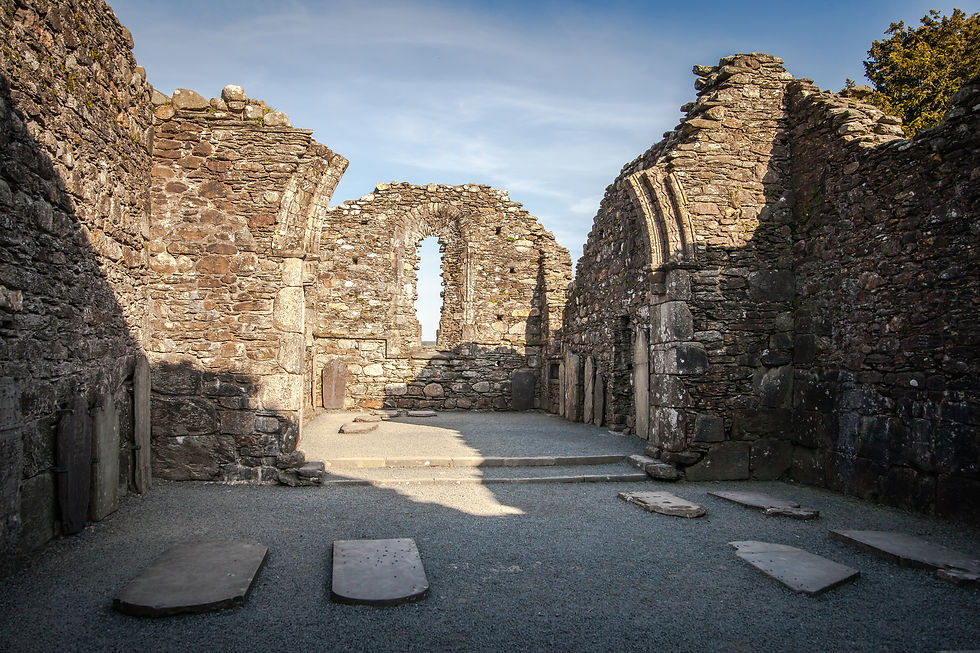
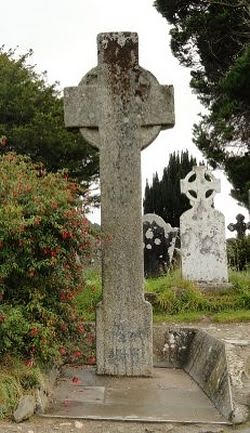
The remaining buildings date from the 10th to 12th centuries. Among the ancient monuments that can still be seen and visited in Glendalough we should mention the following objects: the gates to the monastic city (unique in all Ireland); a Celtic “round tower” 30 meters (c. 98 feet) high (such towers were erected in Ireland as bell-towers, but they were also used as storages and sites of refuge from the risk of raids); a majestic cathedral unfortunately currently in ruins, some parts of which date back to the Norman period; St. Kevin’s cross near the cathedral which is made from a single piece of local granite (it is considered as a rare relic because many pilgrims believe that he who manages to embrace the entire cross with both hands can expect the fulfilment of his or her prayer requests very soon); the priests’ house in the Romanesque style that was partly rebuilt in the 18th century (priests were buried inside it and St. Kevin’s relics may have been preserved there as well); St. Kevin’s fine church (also called “St. Kevin’s kitchen”); the church of Kieran of Clonmacnoise, whose ruins were discovered in the late 19th century; the churches of the Mother of God (one of the earliest ones in this place), of the Holy Trinity, Christ the Savior and the “Reefert church” whose name suggests that kings were buried there.
Interestingly, closer to the upper lake, there are the roofless St. Kevin's cell (it is 3.6 meters, or approximately 12 feet in diameter, built in the shape of a circular "beehive" hut where the saint used to pray alone), St. Kevin's cave (mentioned above), and a very ancient church near it, where early crosses can be found. The saint reportedly established several similar cells around Leinster for his students, ordering them to observe the monastic rule he had taught them. St. Kevin's cave, or "bed", which is completely intact, is today difficult to approach, but pilgrims can still see it. A holy well attributed to St. Kevin is located near the "monastic city" ruins, however it is dry for a portion of the year.
According to many researchers, St Kevin is also intimately related with Kilnamanagh in South Dublin, Leinster. As a young man, he could have studied, led an ascetic life, or perhaps started a monastery. The church of St. Kevin stood here for many centuries, most likely on the site of his labours, but it was demolished in the late twentieth century due to tremendous development in the neighbourhood. The ancient holy well of St. Kevin in Kilnamanagh, which has curative powers, still exists, albeit with limited access; a new church in his honour was recently built in this town. Churches dedicated to St. Kevin, both Catholic and Protestant, can be found in Ireland, Scotland, the United States, Canada, and Australia. "Kevin" (in this and other variations) remains a popular birth name in France, Norway, the Netherlands, Ireland, the United Kingdom, Sweden, Hungary, Slovenia, and Chile.
One of the most widely known poems of the Nobel prizewinner Seamus Heaney (1939 - 2013), 'St Kevin and the Blackbird', relates the story of Kevin holding out his hand with trance-like stillness while a blackbird builds a nest in it.
St Kevin and the Blackbird (1996)
"And then there was St Kevin and the blackbird.
The saint is kneeling, arms stretched out, inside
His cell, but the cell is narrow, so
One turned-up palm is out the window, stiff
As a crossbeam, when a blackbird lands
And lays in it and settles down to nest.
Kevin feels the warm eggs, the small breast, the tucked
Neat head and claws and, finding himself linked
Into the network of eternal life,
Is moved to pity: now he must hold his hand
Like a branch out in the sun and rain for weeks
Until the young are hatched and fledged and flown.
And since the whole thing's imagined anyhow,
Imagine being Kevin. Which is he?
Self-forgetful or in agony all the time
From the neck on out down through his hurting forearms?
Are his fingers sleeping? Does he still feel his knees?
Or has the shut-eyed blank of underearth
Crept up through him? Is there distance in his head?
Alone and mirrored clear in love's deep river,
'To labour and not to seek reward,' he prays,
A prayer his body makes entirely
For he has forgotten self, forgotten bird
And on the riverbank forgotten the river's name."
Something for the kids too.
Holy Father Kevin of Glendalough, pray to God for us!
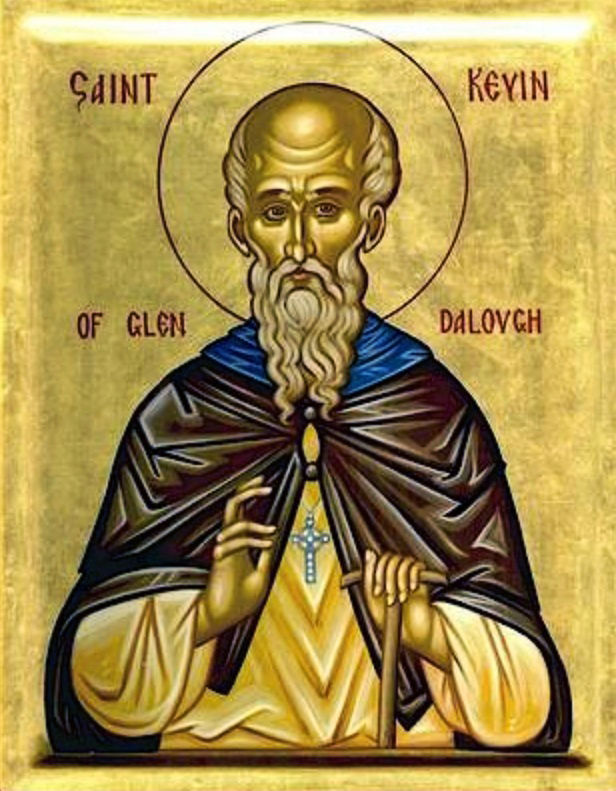
Feast day June 3 NC / 16 OC
Troparion 1st — Tone 8
In you, O Father, was preserved with exactness what was according to the image; / for you took up the Cross and followed Christ. / By so doing, you taught us to disregard the flesh, for it passes away; / but to care for the soul, since it is immortal. / Therefore, O Venerable Kevin, your spirit rejoices with the Angels.
Troparion 2nd — Tone 8
Thou wast privileged to live in the age of Saints, O Father Kevin, / being baptized by one Saint, taught by another and buried by a third. Pray to God that He will raise up Saints in our day to help, support and guide us into the way of salvation.
Kontakion — Tone 2
(Podoben: “You sought the heights...”)Having divinely armed yourself with purity of soul / and firmly grasping unceasing prayer as a spear, you have slain the armies of the demons. / Therefore, we beseech you, O Father Kevin: / “Always intercede for those who honor you.”
Sources: orthochristian.com , oca.org , poetrybyheart.org.uk , en.wikipedia.org


Comments