
St Winifred and Holywell the Healing Spring

Saint Winifred (or Winefride; Welsh: Gwenffrewi; Latin: Wenefreda, Winifreda), was born in North Wales in the early seventh century, when Christendom was still intact and many renowned saints lived on the British Isles. She was of aristocratic descent, descended from the early Welsh kings of Powys, and the sole daughter of Tyfid, Lord of Abeluyc (Trefynnon, subsequently named Holywell), Maenwen, and Gwenffynnon in Tegeingl.
Her uncle from her mother's side was St. Beuno, the abbot of Clynnog Fawr in Gwynedd. Following troubles with the local rulers of Clynnog, St. Beuno sought refuge with his sister's household, and after facing difficulties with the local rulers of Clynnog, St. Beuno found refuge in his sister's household, where Lord Tyfid granted him some land. some land from her Lord Tyfid. St. Winifred was taught the faith by her uncle at a young age, and she decided to devote her life to God and become a nun. She lived under St. Beuno's care, near a chapel he had erected in her hometown of Abeluyc.

St. Winifred was alone at home one Sunday when St. Beuno was serving the Liturgy at the church. A prince named Caradog was riding by and stopped at the house to request water. When Caradog saw beautiful St. Winifred, he became obsessed with the idea of marrying her.
"The maiden's determination to keep her virginity and become a nun was unwavering, so the prince attempted to take her by force. St. Winifred managed to escape and rushed toward the church, but Caradog caught up with her on horseback. In a fit of rage over her rejection, Caradog struck her with his sword, decapitating her. Her severed head rolled down the hillside toward the churchyard."
When her uncle and the congregation—which most likely included St. Winifred's other relatives—saw what had happened, they were appalled. The wicked Caradog died on the spot. (According to other historical sources, Caradog was murdered by Winifred's brother, Owain, out of vengeance.)

A spring of healing water appeared where St. Winifred's head had fallen. St. Beuno took Winifred's head and reattached it to her body while praying to God for her complete restoration. In everybody's amazement, St Winifred was brought back to life through St. Beuno's prayers.
The two sat on a rock that became known as "St. Beuno's Rock," and her uncle informed her that anyone seeking relief through her prayers at this spot would find it. A crimson mark remained around her neck, a reminder of her miraculous recovery.
With her parents' permission, St Winifred immediately received the monastic tonsure from her uncle. St. Beuno recommended St Winfred to stay in the convent and practise the monastic life, which she did, eventually gathering her eleven honourable virgins and teaching them about the Christian faith. St. Beuno became a missionary and travelled west to Ireland.
St. Winifred made a trip to Rome and was deeply impacted by the monastic life there. When she came home, she organised the "Synod of Winifred," which was attended by other Christian ascetics from Wales, Dumnonia, and the North. The way of the Hermit was the most common ascetic practice in Wales at the time. The synod unanimously concluded that the coenobitic life of the convent she led was safer than the isolated existence. So, after seven years in Abeluyc, St Winifred decided to leave and help create other coenobitic communities.
When she arrived in Gwytherin, she was greeted by her mother's cousin, St. Eleri. St Winifred was delivered to his mother, St. Tenoi, and the two built a double monastery in the area. St. Winifred eventually succeeded St. Tenoi as abbess there.
St. Winifred died on November 3, 660 AD, and was buried in the monastery cemetery.

"In 1138, the saint's relics were transferred to the Benedictine abbey in Shrewsbury, remaining there until they were despoiled and scattered during the Reformation. Only one finger remained, and this precious relic is now treasured and cherished in Holywell's Roman Catholic Church. Unfortunately, her stone chapel was demolished 300 years ago. The monastery's large bell, which could only be tolled by four men, was dismantled for scrap in 1730."
It is above all at Holywell that Saint Winefride is remembered. Through her intercessions, many miracles have been worked at the Holy Well, which can claim to be the oldest place of unbroken pilgrimage in Britain.

A small eighth-century reliquary from Gwytherin, known as the Arch Gwenfrewi (Winifred's Casket), was recently discovered, attesting to her status as a recognised saint nearly from the moment of her death, the oldest such surviving evidence for any Welsh saint.
Veneration of the saint was primarily limited to Wales until the late eleventh and early twelve centuries, when it extended throughout the British Isles. Other wells are dedicated after her, including one in Dublin, Ireland. In 1136. Her remnants were relocated to an elegant shrine in Shrewsbury, although her original tomb and a part were preserved at Gwytherin and Holywell. The spring that had sprung up in Holywell on the site where her severed head fell is still active; the temperature of the water never changes, summer or winter, and the flow is continuous regardless of drought or flood in the area. It is so clear that the pebbles at the bottom are distinctly seen to be stained as though with blood. It is lined with fragrant moss, the Jungermannia oplevoides.
HOLYWELL
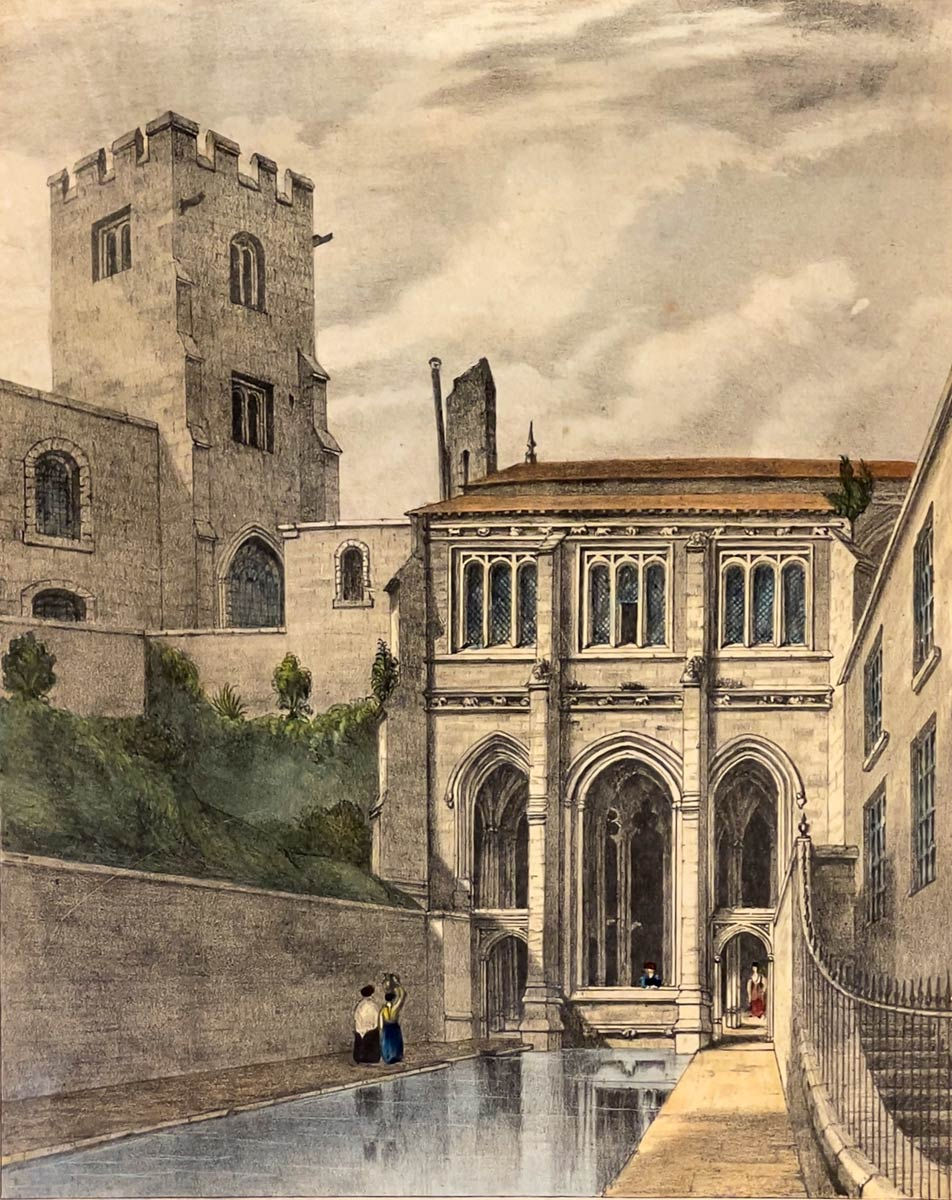
Holywell first appears in written records in 1093, when "Haliwel" was handed to St. Werburgh's Abbey in Chester. In 1240, the Welsh prince Dafydd ap Llewelyn, who was once again in charge of this territory in Wales, donated the holy well and church to the newly built Basingwerk Abbey, where the Cistercian monks cared for the well and its pilgrims until the Reformation.
Winifred's popularity, and hence the fame of the Well, grew throughout the Middle Ages, although nothing is known about the pilgrimage. By 1415, her feast had become a significant festival in Wales and England. Kings could be seen among her pilgrims. Henry V arrived in 1416. Richard III kept a priest at the well. But devotion reached its pinnacle during the time of Welsh King Henry VII, with the construction of the current well-shrine under the patronage of Henry's mother, Margaret Beaufort.

Such glory was fleeting, but the Well's reputation was never eclipsed. The Reformation destroyed shrines and pilgrimages, but no attempt was ever successful in eradicating devotion to St. Winifred at her Well. Despite the years of religious persecution, pilgrims, both Catholic and non-Catholic, continued to visit Holywell. It became the epicentre of Catholic opposition. James II and his queen went to the Well in 1686 to pray for an heir. But James was exiled, and the persecution resumed. Throughout the years, the Jesuits served Holywell and its pilgrims. They wrote popular lives of the saint and even ran inns in town where Mass could be performed in relative safety.
In the nineteenth century, following Catholic Emancipation, the Jesuits monitored and directed the pilgrimage's spectacular renaissance. A church built in the town in the 1840s was regularly expanded and improved.
"A pilgrim's hospice was built shortly after. And under Fr. Beauclerk in the 1990s, the pilgrimage experienced a mediaeval revival. Thousands of pilgrims arrived, forcing the construction of a branch train connection into town. The popular press covered each reported cure."
The sick reported so many cures that Holywell became known as the 'Lourdes of Wales'. Despite changes in pilgrimage patterns brought forth by the increasing secularism of twentieth-century life, as well as devotional shifts within Catholicism itself, the Jesuit legacy lives on: people continue to visit Holywell on pilgrimage.
THE WELL CRYPT AND CHAPEL

Unlike Gwytherin, which houses the saint's burial and other relics, and Shrewsbury Abbey, which enshrined Winifred's body after 1138, the Holywell pilgrimage has traditionally focused on the Well. A church, almost undoubtedly on the site of the current Anglican church of St James, overlooking the Well, has stood by it since 1093, and most likely since Winifred's time. There may perhaps have been another little chapel that was more immediately related to the Well. However, we have no idea what the Well looked like during the Middle Ages. Celtic holy wells can take many different forms, and it is probable that there was no construction around the spring itself until the end of the fifteenth century, as suggested by mediaeval Welsh votive songs. The spring's sheer force would provide support for this.

The current magnificent structure was built around 1500 and likely took ten or fifteen years to finish. It is unique, with no parallels whatsoever in Europe, and is a masterpiece of late Perpendicular architecture. It takes the form of an almost square crypt, buried into the steep hillside but exposed to the north via a triple arcade that leads to the Well. In the center, the spring rises in a star-shaped basin before flowing into an oblong bath with steps at either end. Graceful columns rise all around the Well to support the artistically vaulted roof, and in the center, directly over the source, is a massive pendent boss, magnificently carved with the St Winifred legend but now severely eroded. Originally, the spaces between the columns were filled with beautiful Gothic tracery, which the Puritans destroyed. An open gallery in the west wall provided the pilgrim with his first glimpse of the holy well as he descended from the chapel above to approach the crypt through the now-closed door.
The chapel has a nave and a side aisle and is erected directly above the crypt. To house the altar, an apse was built into the hillside at its east end. The well-crypt has never stopped being utilised for its original purpose, but the chapel has been repurposed for a variety of purposes, including courthouses and schools. As a result, it sustained significant damage, although it was fully restored and re-roofed in 1976. The chapel's interior and exterior are adorned with beautiful, and often amusing, sculptures.
Given the excellent quality of the building and the level of technical ability required to build directly over the source of a tiny river, it's surprising that no hard facts about its construction have survived. We don't know who designed the shrine, who paid for it, or when it was built. The building itself provides the only hints. The emblems and coats of arms carved on the crypt ceiling bosses allude to the sponsorship of Margaret, Countess of Richmond and Derby, Henry VII's pious mother. Margaret died in 1509. The arms of Catherine of Aragon imply additional royal support, while other emblems represent the beneficence of other noble families. Such patronage, which alone could account for the building's splendour, is also the only true clue to its date in the first decade of the sixteenth century.
Though its exact origins will likely stay unknown, the shrine is an appropriate site for the only British pilgrimage to have persisted for over 1300 years.
THE HOLYWELL CURE TRADITION

People have been bathing in St Winifred's Well for 1,350 years. They still do. Pilgrims now journey through the little inner bath three times, saying their opening prayers before entering the outer pool to end their prayers kneeling on St Beuno's Stone near the steps. Some pray for a cure, while others "give as an offering to God" the endurance of the freezing waters for a cure or for the benefit of friends and family members, in honour of St. Winifred, or as a show of gratitude. Pilgrimage has numerous reasons.

This practice is as ancient as the journey itself. Maen Beuno, or St Beuno's Stone, connects us directly to the period of St Winifred.
"According to the Mediaeval Lives, Beuno sat on this stone when he told Winifred that anyone who came to the Well and asked for something in her name, "might receive an answer to their request at least the third time."
This was interpreted to suggest that the petitioner should bathe three times. Following the construction of the existing Well, this required three dives in the small bath. A carving opposite the spa depicts healthy pilgrims carrying the sick through the waters on their backs. The stonework of the Well is covered in hundreds of graffiti, including the initials of hopeful or thankful pilgrims. Some inscriptions specifically refer to cures received at the site.
The outside pool was not originally part of the church and was constructed later; yet, its magnitude attests to the large number of pilgrims who visited even during times of religious persecution. Their trust was not in vain. For 800 years, there has been a consistent record of cures and other favours claimed at the Well through St Winifred's prayers—the only British shrine with such a long tradition of pilgrimage and healing.
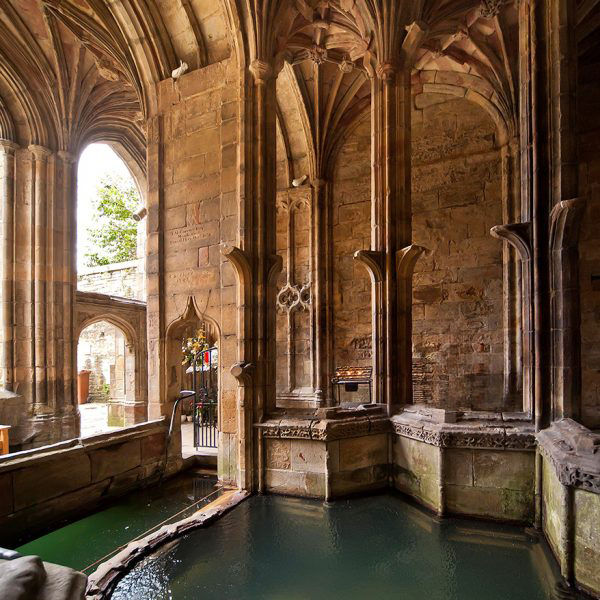
Until the 1960s, the crypt was filled with crutches left by cured pilgrims. Centuries of letters attest to the power of God and His saints in this region, including accounts of cures for Catholics, Protestants, and even individuals who have no faith in anything. One narrative, striking in its simplicity, a scrap of paper left at the Well 100 years ago, can speak for all the others:
"A Protestant Father wishes to express his gratitude to God for miraculously curing his only daughter of a dangerous illness three years ago, despite the efforts of multiple physicians and friends over a three and a half-year period. Signed, C.T. Longley."
Historical references
It is surprising to find that the compilers of the Domesday Book in 1086 failed to mention either well or church, but in less than a decade we have the first written record of a church at Holywell in 1093. It was granted first to Saint Werburgh’s Abbey in Chester, then by Llywelyn Fawr to Basingwerk Abbey. Such was the reputation of the miraculous power of the spring that by the end of the Middle Ages it was described as one of the wonders of Wales.
Saint Winefride’s Well is the only place that can be identified in the late medieval romance Sir Gawain and the Green Knight and the nineteenth century poet Gerard Manley Hopkins expressed its importance as a place of pilgrimage,
“Here to this holy well shall pilgrimages be,
And not from purple Wales only nor from elmy England,
But from beyond seas, Erin, France and Flanders, everywhere,
Pilgrims, still pilgrims, more pilgrims, still more poor pilgrims.. . . . . . . . . . .
What sights shall be when some that swung, wretches,
on crutches Their crutches shall cast from them on heels of air departing
Or they go rich as roseleaves hence that loathsome came hither!”
King Richard I (Richard the Lionheart) visited the site in 1189 to pray for the success of the crusade. The English monarchy had an almost continuous link with the shrine for nearly 140 years (1398-1536/7. They employed a priest for daily prayers and masses to be said for themselves and the souls of their ancestors in their chantry. Edward IV came on pilgrimage and Richard III, in 1484, ‘out of devotion to St Winefride’ provided a generous annuity for the maintenance of a chantry priest. Henry V was said by Adam of Usk to have travelled there on foot from Shrewsbury in 1416 after his victory at Agincourt and Henry VII renewed the financial provision after his victory at Bosworth in 1485. Until the Reformation Henry VIII maintained several chaplains.

Commemorated November 3 NC / 16 OC
The Troparion of Saint Winifride in Tone 4.
"Suffering death for your virginity, O holy Winifride, through God’s mercy your body was made whole and restored to life. Thy healing grace flows in streams of living water. Pray to God for us, that our souls may be saved."
Sources: orthochristian.com , wikipedia.org , shrewsburyorthodox.com


Comments