
St Adomnan, the Venerable Abbot of Iona in Scotland
Updated: 4 days ago
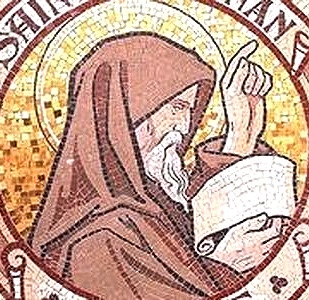
St. Adomnan (Old Irish: [ˈaðəٲ̃ˌnaːn]; Latin: Adamnanus, Adomnanus; c. 624 - 704), also known as Eunan (/ˈjuːnən/ YOO-nən; from Naomh Adhamhnán). The name Adamnan is, according to Cormac's Glossary, an Irish diminutive of Adam. It is generally pronounced in three syllables, but its proper Irish pronunciation is Awnaun, the "d" and the "m" being both aspirated.
St Adomnan was a hagiographer, statesman, lawyer, and one of the most important Christian figures in the history of Scotland and Ireland. St. Adomnan was one of Ireland's 'Twelve Apostles,' Caledonia's Enlightener, and the founder of the Monastery of the Isle of Iona. He was the ninth abbot of Iona (r. 679-704) and is credited with writing "the Life of the Venerable Columba" (†9 June) of Iona. This biography is the most important surviving book in early-medieval Scotland. It provides insight into the life of Iona and the early-medieval Gaelic monks, as
well as important historical information regarding the lives of the Picts.
Early Life

St. Adomnan (also Adamnan, Eunan) was born in Ireland around 624/5, possibly on the site of the current small town of Raphoe in County Donegal, Ulster. Adomnán was a descendant of a cousin of Saint Columba, Colmán mac Sétna. He is though to have been born into a noble family, probably as a younger son. His father's name was Ronan, and his mother was Ronat.


Before moving to Scotland, the holy man studied in one of the monasteries built by St. Columba of Iona (a distant relative) in Ireland. The young St. Adomnan quickly rose to prominence for his wisdom, outstanding understanding of the Holy Scriptures and theology,
excellent teaching skills, humility, and piety. It is likely that St. Adomnan briefly studied and taught at the Irish Monastery of Durrow. Historians believe the saint at one point presided over the Skreen Monastery in the Irish province of Sligo; the location where the monastery stood was once known as "the Seals' Hill."
Monastic Life
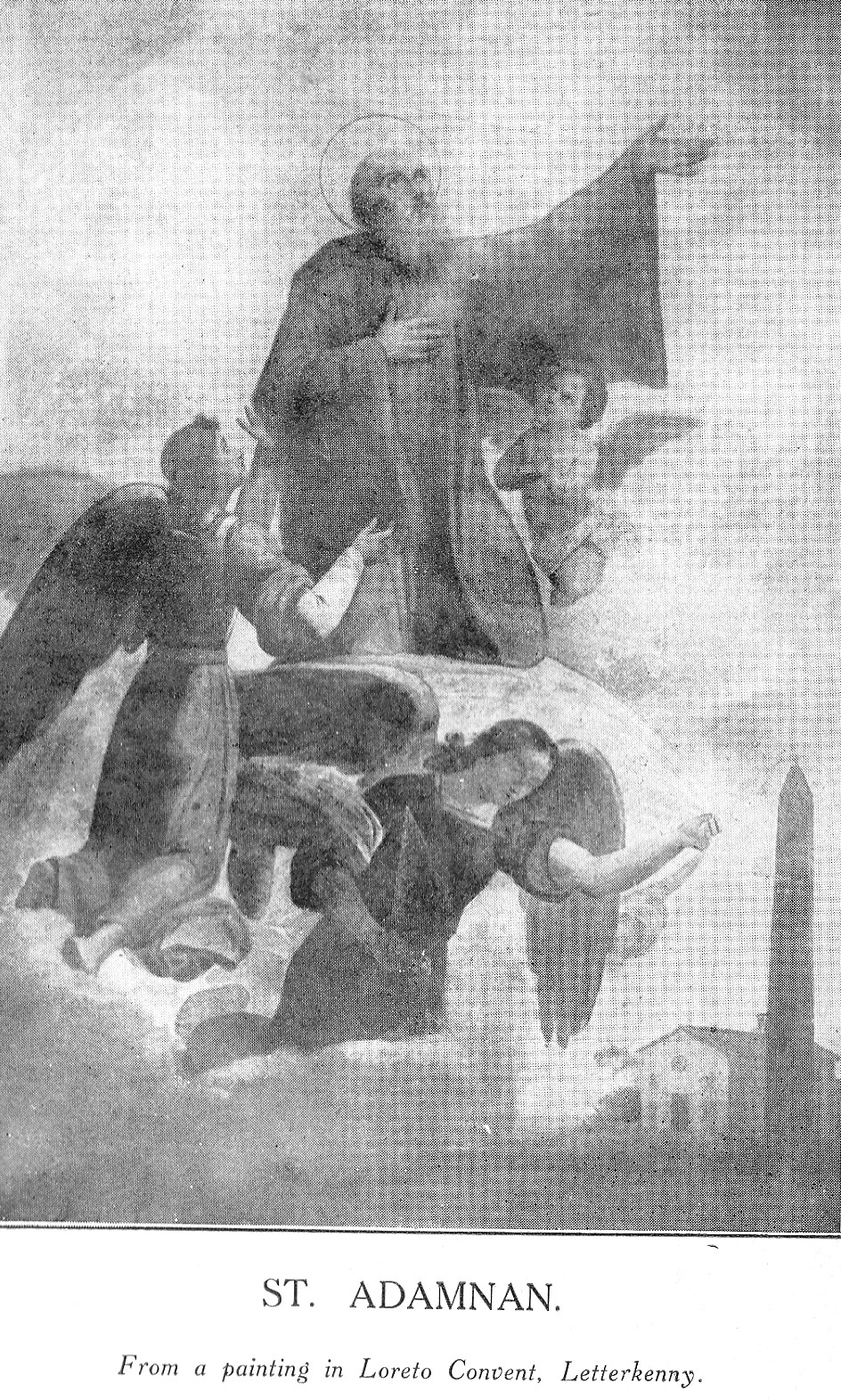
Later, the man of God relocated to Scotland, to the great monastery of Iona, where he oversaw the monastic life under Abbot Segene. In 679, at the age of fifty-five, St Adomnan became the ninth abbot of this historic monastery, and thus one of the great St Columba's successors. St. Adomnan was one of Iona's most wise and industrious abbots throughout its history. He occasionally travelled to northern England and Ireland to proclaim the Good News of Christ. He also carried out a successful mission to what is now known as Perth and Kinross in Scotland, particularly to Glen Lyon, a long glen (a narrow valley).

In about 686, St. Adomnan travelled to the English kingdom of Northumbria to negotiate the release of sixty Irish captives held by King Aldfrith's predecessor, King Ecgfrith. While the negotiations were underway, St. Ceolfrid, the Abbot of the Monastery at Wearmouth, persuaded St. Adomnan of the correctness of Roman practices and customs. Thus, St. Adomnan embraced the Roman way of calculating Easter (which was utilised by all Orthodox Churches) and other customs of the former Patriarchate of Rome. However, the monks of Iona refused to renounce their age-old Celtic rituals, so the holy abbot had to leave Scotland for a while and return to Ireland.

In the year 692, St Adomnan actively participated in a series of Church councils conducted in present-day Northern Ireland, which were quite successful. At the Synod of Birr in 697, the man of God advocated for the implementation of the Roman Paschal cycle in northern Ireland's churches. By that time, the entire Orthodox world had adopted the correct Paschal cycle, as opposed to the old and incorrect one that the Celts continued to observe at the time. In the same year, the saint gained the exemption of women and children from compulsory military duty (a wholly pagan custom) and drafted regulations to protect children and clergy, specifically exempting priests from military obligations. "The Law of Adomnan," also known as "The Law of Innocents," functioned as a statute book and quickly expanded throughout Ireland. In this way, Holly Abbot Adomnan contributed significantly to the country's spiritual and social life, earning the Irish people's respect and gratitude.

St. Adomnan eventually returned to Scotland, where he guided the monastery of Iona until his death. At the monks' request, he authored the most famous version of "St. Columba's Life", which has survived to this day. This is one of the most vivid and outstanding hagiographical works of the era, and it is still read today. St. Adomnan also wrote the book On the Holy Sites, which describes the shrines of the Holy Land based on the tale of a Frankish bishop who was shipwrecked near Britain. St Adomnan knew this bishop personally, and he told him about holy places in Gaul, Egypt, and Constantinople, as well as in Palestine.

Many historians credit St Adomnan with writing many excellent Gaelic poems. Later, he wrote the book,
"The Vision of Adomnan", that was compiled in Ireland. It described his spiritual insights and revelations of Heaven and Hell. This story was very popular in the Middle Ages.
The Story of St Adomnan stopping the plague in Glen Lyon!
Repose

St. Adomnan reposed in peace in the Lord in the year 704 (or 705, according to another source), an elderly man revered by everybody for his outstanding holy life and many years of service to the Holy Church. Sadly, he did not live to witness the moment when Iona accepted the Orthodox method of calculating Easter—which occurred in 716. Following his death, St. Adomnan's adoration expanded throughout Scotland and Ireland. Residents of Scotland and Ireland revered him as one of their most important intercessors and benefactors, contributing significantly to their histories. Surprisingly, the saint remained a peacemaker even after his death and cared for his people. The following tale illustrates this point. For about a quarter century, St. Adomnan's relics rested on Iona. But in 727, a fight between two clans erupted in Ireland. The monks transported the saint's remains to Ireland and visited forty churches that administratively belonged to Iona, hoping to reach a truce via God's mercy and St. Adomnan's prayers. And it became possible to reach a truce pretty quickly. Many people swore an oath on the holy abbot's relics, promising to follow "The Law of Adomnan".

The Vikings desecrated the shrine of St. Adomnan twice: once in the ninth century and again in the eleventh century, exactly 200 years apart.

Many churches in the Scottish county of Aberdeenshire, Angus, and the Hebrides have been dedicated to St. Adomnan from ancient times. The ruins of the chapel dedicated to St. Adomnan can still be seen at Nether Leask, Aberdeenshire, today. Since ancient times, there have been churches dedicated to this saint in Donegal, Sligo, and Derry, Ireland. An Anglican Cathedral belonging to the Church of Ireland in the town of Raphoe in Donegal, the purported birthplace of St. Adomnan, is dedicated to him and called as "The Cathedral Church of St. Eunan". St. Columba erected a monastery on this spot several decades before St. Adomnan was born. In this town, churches were built to honour both of these saints during the Middle Ages.
Furthermore, there is a united Anglican Diocese of Raphoe and Derry in the Church of Ireland, which has two cathedrals—the Raphoe Cathedral of St. Adomnan and the Cathedral of St. Columba in Derry—as another tangible link between these two saints. St. Adomnan is the patron saint of the Roman Catholic Diocese of Raphoe. Along with St. Columba, he is the patron saint of Letterkenny, a Catholic cathedral on the River Swilly in Donegal (built in the late nineteenth century). This chapel was erected in the Victorian Neo-Gothic style, and the great inner arch depicts episodes from St. Adomnan's life. The Cathedral has twelve bells, each named after an Irish saint with some connection to the area, notably St. Adomnan. Letterkenny also has a college named after St. Adomnan.

In Glen Lyon, Scotland, there are several precious surviving relics of St Adomnan. One of these is the early 8th-century bell known as "The St. Adomnan's bell" which is housed in the church of the village Innerwick (Unfortunately St Adamnan's Bell was stolen from Insh Church in September of 2017. I visited Insh in 1995 to see the bell, and was surprised to find it mounted on the church wall, completely unattended); another relic is the big historic St. Adomnan's cross that stands along the roadside two miles away from the Innerwick church. In the same glen, there is also a very ancient church (now unused) in the village of Dull in Perth and Kinross, built on the site of a monastery founded by St Adomnan. Archaeologists have uncovered early crosses and a font from that period near the church, on the former abbey grounds.
Finally, there is a very old chapel called St. Adomnan's Church in the parish of Lonan on the Isle of Man's eastern shore. This chapel is also known as "the old Lonan church". Its origins are unclear, however the land on which it stands was owned by Cumbria's St. Bees Priory throughout the Middle Ages. There are several Celtic crosses in the churchyard of St. Adomnan's Church, the oldest of which goes back to the fifth century.
Holy Father Adomnan, pray to God for us!
Feast Day: September 23 NC / October 6 OC
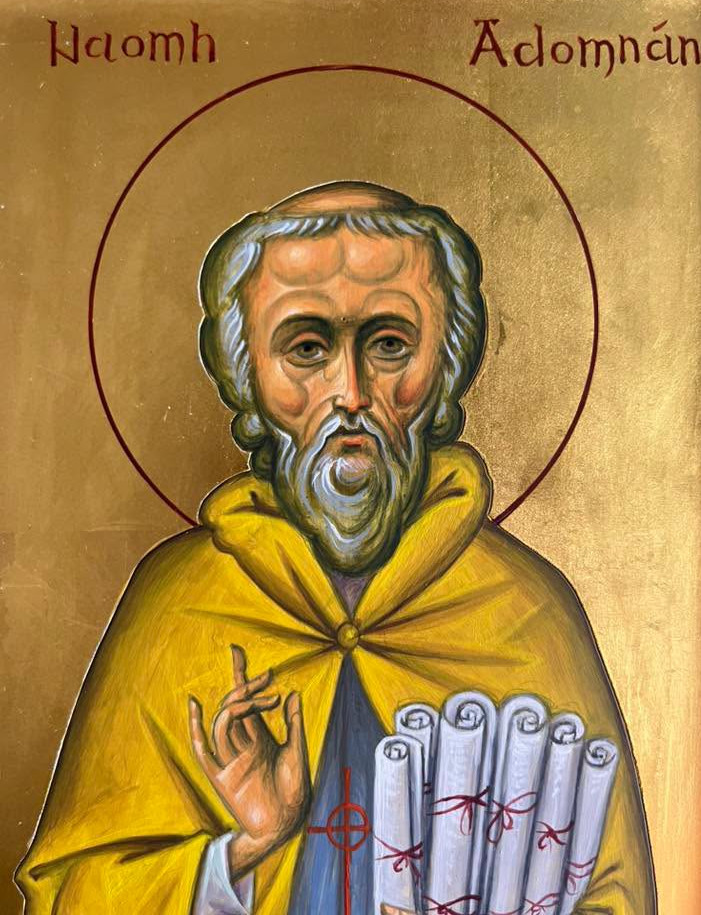
Troparion of St. Adomnan (Tone 4)
O holy father Adomnan, Thou didst shine forth from the holy isle of Iona as a beacon of the True Faith. As a wise pastor and writer of the lives of the saints, Thou didst labor for the peace and unity of Christ's Holy Church. By thy prayers, O venerable one, Entreat Christ our God to grant great mercy to our souls.
Kontakion of St. Adomnan (Tone 3)
Today the island of Iona rejoiceth, And with her the faithful of Ireland and Scotland make glad; For they possess thy holy memory as a fountain of healing. O righteous Adomnan, praise of monastics and defender of the helpless, Intercede unceasingly for us who honor thee.
Sources: roarch.org.uk , orthochristian.com , wikipedia.org


Comments