
The Life of St Aristovoulos of the Seventy. Apostle of the British Isles
- Jul 22
- 4 min read
Updated: 3 days ago

The story of Apostle Aristovoulos of the Seventy offers a fascinating glimpse into early Christian history and its spread beyond the Mediterranean. Known as one of the seventy disciples sent out by Jesus, Aristovoulos is traditionally recognized as the first Bishop of Britain. As regards folk memory, the British Achau, or Genealogies of the Saints, say that St Aristobulus was known as Arwystli Hen (the Elder) and that he came to Britain with others, Jewish converts, and also his own son, called ‘Manaw’. His journey and mission reveal how Christianity took root in distant lands during the first century. This post explores his life, his role in the early Church, and his lasting impact on Britain.
Who Was St Aristovoulos of the Seventy?
St Aristovoulos was one of the seventy disciples mentioned in the Gospel of Luke (Luke 10:1-24). Unlike the Twelve Apostles, the Seventy were sent out in pairs to preach and heal, spreading Jesus’ message to surrounding regions. St Aristovoulus stands out because of his Christian Missionary work in Britain, a place far from the usual centers of early Christianity.
"The Holy Apostle Aristóvoulos of the Seventy was born on Cyprus. He and his brother, the Apostle Barnabas, accompanied Saint Paul on his missionary journeys. Saint Aristóvoulos is mentioned by the Apostle Paul in his Epistle to the Romans (Romans 16:10)."
There are several conflicting narratives about the hierarch's life before he went to Britain. Some identify him with Zebedee, the father of the Apostles James and John. Others say that he was the father-in-law of the Apostle Peter. Most of these are unreliable, however.
Saint Paul made St Aristóvoulos a bishop and sent him to preach the Gospel in Britain, Scotland, and Hibernia (Ireland), where he converted many people to Christ. He also had to endure many torments and afflictions from hostile pagans, who beat him and mocked him. Eventually, he won them over and brought them to Christ as well.
St Aristovoulos’ Mission to Britain

His mention in Paul's Letter to the Romans, where greetings are extended to those "of Aristovoulos," indicates that he belonged to a household or community known for their faith. Aristovoulos, the teacher-shepherd who was immediately entrusted with divine commission, travelled with St. Paul as part of the apostolic mission to bring the Gospel to new peoples.
According to Church tradition, Paul ordained Aristovoulos as Bishop and assigned him to preach the Gospel in Britain, Scotland, and Hibernia (Ireland). There, found Britain inhabited by a warlike and fierce race, He was beaten, dragged as a criminal along streets and suffered misfortune, malice and mockery. Finally, local people accepted from him the Light of Christ. He taught them the Faith, baptised them, built churches and ordained priests and deacons, through steadfast courage and divine grace, he led many to Christ. During his journey to Britain, he also preached to Celtiberian tribes in northern Hispania (north-central Spain).
"The exact timeline of St Aristovoulos’ mission is uncertain, but tradition places his journey to Britain in the mid-first century, possibly around 40-60 AD. This was a time when the Roman Empire controlled Britain, and the island was a melting pot of Celtic tribes and Roman settlers."
The Historical Context of Christianity in Britain
"Christianity’s arrival in Britain predates the well-known missionary efforts of St. Augustine in the 6th century. The presence of figures like Aristovoulos indicates that Christianity had already begun to spread during Roman times."
Roman Britain was a complex society with diverse religious beliefs, including paganism and mystery cults. Aristovoulos and other early missionaries faced the challenge of introducing a new faith in this environment. Their success laid the groundwork for Christianity’s eventual dominance in Britain.
Mapping St Aristovoulos’ Journey

While no definitive map exists showing Aristovoulos’ exact route, scholars have pieced together likely paths based on historical and archaeological evidence:
Starting from the Eastern Mediterranean, possibly Antioch or Jerusalem
Going to Rome where apparently he had a family
Crossing the English Channel to southern Britain, likely landing near ports such as Richborough or Dover
Moving inland to establish Christian communities in key settlements
This journey would have been very difficult, involving sea travel and navigating unfamiliar and hostile territories. The map below illustrates a probable route Aristovoulos might have taken.
His Repose

Saint Aristóvoulos reposed peacefully in Britain among the people he had evangelized. Some sources say he suffered a martyr's death in Wales near the River Severn in what was Montgomeryshire in Wales used to be called ‘Arwystli’, at an advanced age.
St Aristovoulos’ story highlights the courage and dedication required to spread the Light of Christianity in hostile and unfamiliar places. His mission reminds us that great faith and conviction can truly cross cultural and geographic boundaries.
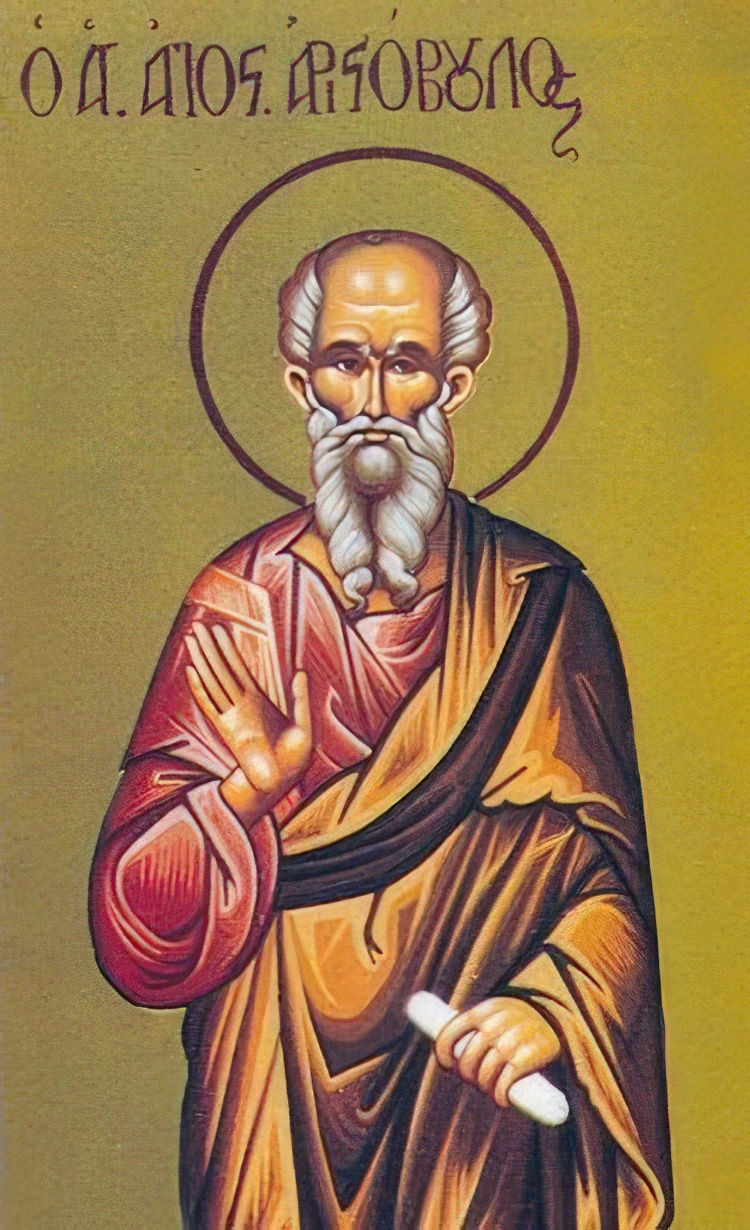
The Church honours St. Aristovoulos on March 15/16, commemorating his apostolic labours and pastoral sacrifice. He is also honoured collectively on January 4 (Synaxis of the Seventy Apostles) and October 31 (with Saints Stachys, Apellēs, Amplias, Urban, and Narcissus).
Troparion
Troparion in 1st Tone
Let us acclaim Stachys, Apelles, Amplias, Urban, Narcissus and Aristobulus as a six-stringed harp of the Spirit, that sings of God's marvelous gifts to mankind. As divine Apostles they pray for us.
Kontakion in 4th Tone
Let us thankfully praise the wise Apostles Stachys, Apelles, Amplias, Urban, Narcissus and Aristovoulos, those treasures of the Holy Spirit and rays of the Sun of glory, who were brought together by the grace of our God.
Sources: OCA , johnsanidopoulos.com , orthochristian.com


Comments