
St Faustus Bishop of Riez
- Jul 24
- 6 min read

St Faustus of Riez was an early Bishop of Riez (Rhegium) in Southern Gaul (Provence), the best known and most distinguished opponent of Pelagianism.
Saint Faustus was a native of Britain. He was educated as a lawyer and philosopher but, since his greatest care was to acquire true wisdom, he became a monk at the renowned Monastery of Lerins, putting himself under the spiritual direction of Saint Honoratus (Jan. 16) and Saint Caprasius (June 1). His humility, obedience, meekness and zeal in the ascetic struggle enabled him to make rapid progress in the monastic virtues, so that he was highly regarded by the Holy Abbot Maximus (Nov. 27), and by other brethren. When Maximus was appointed Bishop of Riez in Provence in 434, Faustus succeeded him as Abbot of Lerins.
During the twenty-seven years of his abbacy, Saint Faustus ensured that the monastic life at Lerins was well-ordered and faithful to the tradition of the Eastern Fathers. He defended the monastery's right to freedom from interference by Bishop Theodore of Frejus, who called a synod at Arles in 453 to give canonical authority to his claims.
But the synod reinstated Faustus and decreed that the Bishop of Frejus should respect the independence of the monastery, and be content with ruling his own diocese. On his return to the monastery, the holy Abbot Faustus, who was a model of all the virtues, continued to direct his monks until the death of Saint Maximus in 461, when he was constrained to accept the bishopric of Riez despite his humble reluctance.
Far from abandoning monastic ascesis for episcopal splendor, the new Bishop was the equal of the most austere anchorites in fasting and vigils.

He brought to his cathedral church the liturgical customs of the Monastery of Lerins and kept in close touch with the all the monasteries, where he would often withdraw for prayer. He never wearied of admonishing his people to give up their pagan ways and live according to the commandments of God. His kindliness won the hearts of everyone he met. When he had completed his usual evening prayer, he would go out dressed as a simple priest, to help the needy and visit prisoners. He was not above bearing on his own shoulders the bodies of poor folk left lying in the highways, and burying them. During the terrible famine of 474, he made himself "all things to all people" that he might save his flock. He appointed three days of processions and solemn supplications, gave away what little he had, and begged his friend Patientus (Sept. 11) to send supplies of wheat from Lyons.
During his thirty years as Bishop, Saint Faustus was actively involved in ecclesiastical affairs in Gaul. He was regarded as the leader of the episcopate and the most effective preacher of his day.
He dealt vigorously with the Arian and Macedonian heretics and rebutted their novel idea of predestination, that would deny the cooperation of free will with grace, advanced by some theologians on the basis of the writings of Saint Augustine of Hippo (June 15). Like Saint John Cassian (Feb. 29) and the Greek Fathers, Faustus considered that man, created in the image of God, is called upon to enter by good deeds into a free and dynamic relationship with his Maker, in order to beautify the image and make it radiant in the likeness of God. This doctrine was approved by the Bishops of Gaul in the Synods of Arles and Lyons.
“Throughout his life Faustus was an uncompromising adversary of Pelagius, whom he styled Pestifer, and equally decided in his opposition to the doctrine of Predestination which he styled “erroneous, blasphemous, heathen, fatalistic, and conducive to immorality.” This doctrine in its most repulsive form had been expounded by a presbyter named Lucidus and was condemned by two synods, Arles and Lyons (475). At the request of the bishops who composed these synods, and especially Leontius of Arles, Faustus wrote a work, Libri duo de Gratiâ Dei et humanae mentis libero arbitrio, in which he refuted not only the doctrines of the Predestinarians but also those of Pelagius (PL, LVIII, 783). The work was marred, however, by its decided Semipelagianism, for several years was bitterly attacked, and was condemned by the Synod of Orange in 529 (Denzinger, Enchiridion, Freiburg, 1908, no. 174 sqq. – old no. 144; P.L., XLV, 1785; Mansi, VIII, 712). Besides this error, Faustus maintained that the human soul is in a certain sense corporeal, God alone being a pure spirit. The opposition to Faustus was not fully developed in his lifetime and he died with a well-merited reputation for sanctity. His own flock considered him a saint and erected a basilica in his honour. Faustus wrote also: Libri duo de Spiritu Sancto (P.L., LXII, 9), wrongly ascribed to the Roman deacon Paschasius. His Libellus parvus adversus Arianos et Macedonianos, mentioned by Genadius, seems to have perished. His correspondence (epistulae) and sermons are best found in the new and excellent edition of the works of Faustus by Engelbrecht, Fausti Reiensis praeter sermones pseudo-Eusebianos opera. Accedunt Ruricii Epistulae
On a Sermon for the Epiphany, talking about the wedding feast at Cana, Faustus has said: “On the third day there was a wedding. What wedding can this be but the joyful marriage of man’s salvation, a marriage celebrated by confessing the Trinity or by faith in the resurrection.
That is why the marriage took place ‘on the third day,’ a reference to the sacred mysteries which this number symbolizes. Hence, too, we read elsewhere in the Gospel that the return of the younger son, that is, the conversion of the pagans, is marked by song and music and wedding garments. Like a bridegroom coming from his marriage chamber our God descended to earth in his incarnation, in order to be united to his Church which was to be formed of the pagan nations. To her he gave a pledge and a dowry: a pledge when God was united to man; a dowry when he was sacrificed for man’s salvation. The pledge is our present redemption; the dowry, eternal life. To those who see only with the outward eye, all these events at Cana are strange and wonderful; to those who understand, they are also signs. For, if we look closely, the very water tells us of our rebirth in baptism. One thing is turned into another from within, and in a hidden way a lesser creature is changed into a greater. All this points to the hidden reality of our second birth. There water was suddenly changed; later it will cause a change in man. By Christ’s action in Galilee, then, wine is made, that is, the law withdraws and grace takes its place; the shadows fade and truth becomes present; fleshly realities are coupled with spiritual, and the old covenant with its outward discipline is transformed into the new. For, as the Apostle says: The old order has passed away; now all is new! The water in the jars is not less than it was before, but now begins to be what it had not been; so too the law is not destroyed by Christ’s coming, but is made better than it was.”
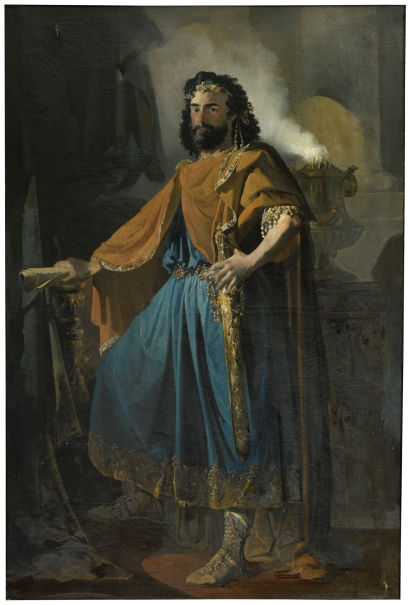
When Euric and the Visigoths invaded southeastern Gaul, Saint Faustus was one of the embassy of four bishops who sought terms of peace; but they were unable to restrain the bloodthirsty temper of the barbarians as they ravaged Provence, spreading the Arian heresy. Saint Faustus threw himself into the battle by prayer and fasting. Each day he met with the people and clergy, and exhorted them to keep the Orthodox faith, even at the cost of their blood and despite the threats of Euric, by whom he was exiled and imprisoned at Limoges. Faustus was able to return to his diocese on the death of Euric in 485. His spiritual children welcomed him back with shouts of triumph and tears of joy. He died in peace there at about one hundred years old, in 495.
The Western Church, which was completely won over to the Augustinian position, later came to regard the teaching of Faustus as heresy (known as Semi-Pelagianism). Yet this doctrine, in fact, reflected the common tradition of the Church.
Saint Faustus’ liturgical fest is on September 28.


Comments