
St Nectan the Holy Martyr of Hartland
- Aug 1
- 8 min read
Updated: 4 days ago

St. Nectan was born in Wales in the second half of the fifth century, according to his only surviving biography that dates back to the 12th century. He was most likely the eldest son of the holy Welsh King Brychan of Brecknock.

The latter had numerous sons and daughters who are all revered as saints and missionaries, having evangelized regions of Wales and Cornwall. St. Morwenna, one of Nectan's famed sisters, is still remembered by the devout in the community of Morwenstow, Cornwall. St. Nectan lived in the modern-day county of Devon in southwest England. The saint's spiritual labours were carried out precisely in this county, which was then part of the British kingdom of Dumnonia, which stretched from Cornwall to Somerset.
A "Life of Nectan", along with an account of the finding of his body and a collection of miracle stories, can be found in a 14th-century manuscript now in Gotha. His "Synaxarion" has been dated to the end of the 12th century.
Nectan's feast day is 17 June, the traditional day of his death (traditionally around 510), which was kept in Launceston, Exeter and Wells; there is still a tradition of taking foxgloves to his well on that day. Other dates include the 18 May, 14 February and 4 December (the date of his translation).
Early Ascetic Life
As a young man, St Nectan resolved to become a monk and devote his life to God, following in the footsteps of Egypt's Holy Fathers such as St Anthony the Great. So, with a number of his pious relatives, St Nectan boarded a boat, making a promise to live a hermit's life at the location where his boat would land. The boat came to a halt near Hartland on Devon's northwestern coast.
"Our ascetic settled and began his holy life in Stoke, which is now part of Hartland. (The old English term "stoc'", or the contemporary form "stoke", implies "an outlying farmstead", "a stockaded place", "a monastery", or "a cell". As a result, the name "stoke" appears in sections of many English villages with a monastery, such as Basingstoke in Hampshire and Stoke-by-Nayland in Suffolk."
For many years, the venerable hermit of Hartland lived a severe ascetic life in a deep forest near a spring on the site of the present-day holy well of St. Nectan.
He may have erected a small hut for himself there and prayed fervently all day and night. He just ate berries and herbs. For years, no one knew about his existence. Nectan's relatives eventually settled in Devon, where they passionately proclaimed the Gospel and converted many pagans to Christ. Nectan spent a long time praying in his remote, isolated hermitage, and his relatives paid him visits on a regular basis—once a year around Christmas to pray together and thank God for His goodness.
His Martyrdom

The church tradition tells us that Nectan once assisted a swineherd named Huddon in finding his stray piglets. In gratitude, the swineherd gifted Nectan two magnificent cows that provided him with milk. However, shortly thereafter, a group of robbers stole the saint's cows.
"The venerable hermit discovered the criminals the next day, and rather than chastising them for their wrongdoing, he sought to soften their hearts and convert them to Christ through his preaching. Unfortunately, the evildoers rejected Christ's message, and in a brutal act, they decapitated the Holy Hermit."
According to church tradition, the decapitated Nectan—much to the astonishment of the murderers—held his severed head in his hands and walked towards the spring where he had performed his ascetic labours.
Upon reaching this location, he died peacefully. Witnessing this miracle, one of the robbers immediately embraced faith in the Saviour and buried Nectan's body with honour and devotion. The remaining robbers eventually suffered blindness or met violent ends. Tradition states that this event took place in the year 510, when the saint was approximately 42 years old.
Since then, Nectan has been renowned and loved in "the West Country" as a martyr and wonderworker. According to legend, foxgloves thrived where Nectan's innocent blood was poured. Many ancient local legends and stories are linked to Nectan.
As a result, it is thought that he spent some time as a recluse in the modern-day village of Trethevy on Cornwall's northern coast. Another intriguing fact is that the Cornish wood St Nectan's Glen and the nearby waterfall are named after this saint. He most likely erected a modest cell above the waterfall and lived as a recluse for several years in a really picturesque setting in a wooded valley near the sea.
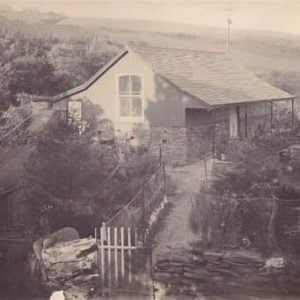
"According to tradition, Nectan owned a little silver bell, which was set on top of a tower in Cornwall. During gales, the saint would ring this bell to keep ships from straying too close to the rocky valley and being wrecked. "
Trethevy also has a chapel and holy spring dedicated to another notable Cornish saint, Piran. The Hartland village community remembered that the saint despised ribaldry in particular, therefore they made every effort to avoid using bad language.
There is a story that in the second half of the 20th century, one teenager did use foul language in the vicinity of this area and nearly died on the spot. —He was healed after demonstrating true repentance and confessing his sin in church.
After Nectan's martyrdom, his relics were put in a shrine, and people flocked there throughout the Middle Ages. Early in the 11th century, the church at Hartland received significant donations, including a magnificent new shrine for his relics, and his personal staff was decked with gold and silver.
"According to tradition, on the eve of the Battle of Brunanburgh in 937, St. Nectan appeared at night to a young man in Hartland who was infected with the plague that was then spreading among the soldiers. The saint touched the young man and cured him totally. The next day, the lad appeared before the pious King Athelstan and told him about the miracle, adding that St. Nectan was requesting that the king pray to God and the saint during the war, and he would be victorious.

The monarch, who had previously known little about this saint, vowed to obey—and won the battle with the saint's assistance. And it wasn't the only miracle; the plague also magically passed, and all of the soldiers recovered. From that point forward, Athelstan regarded St. Nectan in great regard and became a benefactor to his church."
The territory around Hartland has been owned by members of the royal dynasty of Holy King Alfred the Great of Wessex since the 10th century. It was stated that Countess Gytha (c. 997-1069), mother of the last English King Harold and wife of Earl Godwin of Wessex, constructed a church in Stoke (Hartland) in 1050—most likely as a mark of gratitude for her husband's miraculous survival in a storm at sea. In the second half of the 12th century (possibly in 1160), an Augustinian Catholic Abbey was built on the site of Nectan's hermitage near Hartland, and the hermit's relics were stored there until the Reformation.

Hartland Abbey was the last monastic community to be closed by Henry VIII in 1539, as part of England's monastic breakup. While the church remained largely intact, the monastery buildings were either razed or converted to secular use. Today, "Hartland Abbey" is a country estate owned by the Stucley family that attracts tourists due to its furniture and landscaping.

Five ancient churches in Devon and Cornwall were dedicated to St. Nectan. Today, a mediaeval chapel in the village of Welcombe on the Devon-Cornwall border, just south of Hartland, is dedicated to him, as is St. Nectan's holy spring, which was most likely constructed by Nectan himself. Surprisingly, the curate in this particular church for long time was a wonderful English poet, antiquarian, highly devout priest, and visionary, Robert Stephen Hawker (1803-1875), who for many years was rector of Morwenstow church, listed above, where he is still remembered and commemorated. Another Devon Church

dedicated to this saint can be found in the little village of Ashcombe. An historic church at Ashton, Devon, on the outskirts of Devon's Dartmoor national park, was previously dedicated to St. Nectan, but its current patron is St. John the Baptist (a perfect match for a hermit's patron). In Cornwall, a mediaeval 13th-15th century church (sometimes known as a chapel) dedicated to St. Nectan exists near the settlement of St Winnow. This saint has been honoured from ancient times throughout Devon, sections of Cornwall, and towns and cities such as Launceston, Exeter, and Wells.
"But, without a question, the primary center of his worship has always been and continues to be Hartland in Devon, where miracles are constantly performed on the site of this saint's martyrdom. The saint is the village's patron. "
The town is located on the Hartland Point peninsula near the Bristol Channel, also known as a "sea" in the saint's life. It is surrounded by gorgeous seaside landscapes. The nearby 14th-century church, dedicated to St. Nectan, has long served as a pilgrimage destination. It is located in Stoke, not far from Hartland's core. This church is one of the best and longest in Devon (approximately 137 feet long), and its tower, the highest in Devon, stands between 130 and 140 feet tall and can be seen from miles away. This church is a hidden gem, commonly referred to as "the cathedral of North Devon". It is reported that St. Nectan's relics can still be found beneath the floor. Mary Norton (1903-1992), a children's writer best known for her fantasy novels The Borrowers, is buried in St. Nectan's Churchyard in Hartland.
A holy well dedicated to St. Nectan is located 100 meters (328 feet) from the church, which may be the exact location of the saint's spiritual labours. There was also a Roman Catholic parish in Hartland called Church of the Mother of God and St. Nectan, which regrettably closed in 2010. There is a historical tradition of delivering foxgloves to Nectan's well on his feast day, June 17 (June 30 OS). (In England, there is a historical tradition of "dressing" holy springs and wells with flowers and greenery on particular church feasts). Several stones near the well bear the scarlet stains of the holy martyr's blood, which some locals regard as live evidence of the horrific crime and glorious martyrdom that occurred here fifteen centuries ago.1 The faithful have also noticed red streaks of blood at Nectan's well. Every year on June 17, Hartland Church celebrates a festival service in honour of the saint, with children carrying purple foxgloves in a procession around the church (the purple represents the martyr's blood). St. Nectan is still with every pilgrim who comes here.
Two locations in Brittany, France, are named after St. Nectan. Nectan, the holy offspring of the saintly King Brychan, outperformed all of his numerous holy siblings and sisters via his God-pleasing life and martyrdom. He is one of numerous Celtic saints who lived in the 5th-7th centuries as hermits and missionaries in southwestern England, Wales, Ireland, Scotland, and Brittany.
St. Nectan, Holy Martyr of Christ, please pray for us!

Commemorated June 17
Troparion — Tone 4
O holy Father Nectan / you followed the bidding of the Lord / and left your father and mother for His sake to embrace the hermit’s life. / Faithful follower of Christ unto death / pray that He may save our souls.
Kontakion — Tone 2
(Podoben: “You sought the heights...”)You appeared as a bright star announcing Christ with your radiance, / which is repulsive to this world, O Martyr Nectan; / extinguishing the allure of false gods, / you enlighten the faithful, / always interceding for us all.
Sources: Dmitri Lapa , Wikipedia , orthodoxchristian.com , oca.org


Comments