
St Patrick, Equal to the Apostles, Bishop of Armagh, Enlightener of Ireland
- Jul 26
- 11 min read
Updated: 13 hours ago

People all over the world every year celebrate his feast day, though it is usually by consuming alcohol, wearing the color green, and perhaps decorating with four-leaf clovers. But who was St. Patrick? What kind of life did he live?
Early life and captivity
Patrick was born in Britain at the end of Roman rule. He came from a family of Romano-Britons, i.e. Romanized Celtic Britons. He would have spoken British Celtic as his mother tongue, the Irish language, and some Latin.
" In his Confessio, Patrick writes that his father, Calpurnius, was a decurion (senator and tax collector) of an unnamed Romano-British town, and also a deacon in the Church; his grandfather Potitus was a priest. However, Patrick writes that he was not religious in his youth, and considered himself in that period to be "idle and callow"."
His birthplace is not known with any certainty, but it is believed to be near the Irish Sea (as he was captured by Irish pirates) and near a large Roman town (as his father was a decurion). Patrick writes that his family hailed from the vicus of Bannavem Taburniae, and that his father had a small villa nearby.

Several places have been proposed. One is the Roman fort Banna (Birdoswald) on Hadrian's Wall, which is near Luguvalium (Carlisle) in Cumbria. Another is Banwen in south Wales,which was the site of a Roman marching camp. The West Country has also been proposed; particularly Banwell-Wint Hill, and Avonmouth, both in Somerset. It has been suggested that the last part of Bannavem Taburniae refers to the Severn (Sabrina) or that it is made up of the Celtic banna (promontory) venta (town) and berniae (a pass or gap). The Roman town of Bannaventa in Northamptonshire is phonically similar to the name Patrick gave, but is probably too far from the sea. Muirchú's 7th century Life of Patrick says that he was born at a place called Nemthor, which in the following centuries was identified with a place near Dumbarton in Strathclyde. Nearby is Kilpatrick, another proposed birthplace.
According to his Confession, he was captured at the age of sixteen from his family's villa at Bannavem Taburniae by a group of Irish pirates. They took him to Ireland where he was enslaved and held captive for six years. Patrick writes in the Confession that the time he spent in captivity was critical to his spiritual growth. He says that God gave him the opportunity to be forgiven his sins and to grow in his faith through prayer.
As a slave, Patrick worked as a herder and was introduced to the Irish culture that would define his life and reputation.
"Patrick does not say where in Ireland he worked. It is believed that Foclut was in the area of his captivity. Patrick writes that after six years of captivity, he heard a voice telling him that he would soon go home, and then that his ship was ready. "
Fleeing his master, he travelled 200 Roman miles (about 188 statute miles or 300 km) to a port, presumably on the eastern or southern coast, where he found a ship and persuaded the captain to take him aboard. It is generally believed that Foclut refers to Foghill (Fochoill, meaning "under-wood") near Killala Bay in Connacht. However, Patrick's hagiographer Muirchú said it was in the area of Slemish mountain (Sliabh Mis) in Ulster.
His Mission
Some time later, he went to Gaul and studied for the priesthood at Auxerre under Saint Germanus (July 31).

Eventually, he was consecrated as a bishop, and was entrusted with the mission to Ireland, succeeding Saint Palladius (July 7). Saint Palladius did not achieve much success in Ireland. After about a year he went to Scotland, where he died in 432.
Patrick had a dream in which an angel came to him bearing many letters. Selecting one inscribed “The Voice of the Irish,” he heard the Irish entreating him to come back to them. Patrick felt a deep calling and received specific visions and vivid dreams from God that he should return to the people who enslaved him: to the Irish in order to bring them to Christ.
"In his Confessio, he recounts a dream he had many years later, where the people near "the wood of Foclut" (silva Focluti or Vocluti), which is "next to the western sea", beseech him to "come and walk again amongst us"."
All of his family, fearing for his safety, begged him to stay home; they argued and even attempted to bribe him. He states that at that time he did not realize the grace God had given him and he found it difficult to argue with them. He knew his calling, but the criticism and lack of encouragement he received made it difficult for him.
Although Saint Patrick achieved remarkable results in spreading the Gospel, he was not the first or only missionary in Ireland. He arrived around 432 (though this date is disputed), about a year after Saint Palladius began his mission to Ireland. There were also other missionaries who were active on the southeast coast, but it was Saint Patrick who had the greatest influence and success in preaching the Gospel of Christ. Therefore, he is known as “The Enlightener of Ireland.”
His autobiographical Confession tells of the many trials and disappointments he endured. While preparing to be made a deacon in Britain, Patrick confessed a sin of his childhood to a dear friend. Around the same time, this friend recommended to the church leaders that Patrick be made a bishop. While Patrick was absent, the friend betrayed him and publicly ridiculed Patrick for his childhood sin.
In his autobiography, Patrick wrestles with this betrayal (not with bitterness, just the sadness of what happened). He cannot understand why someone whom he respected would recommend him as bishop and then betray him.
Saint Patrick founded many churches and monasteries across Ireland, but the conversion of the Irish people was no easy task. There was much hostility, and he was assaulted several times. He faced danger, and insults, and he was reproached for being a foreigner and a former slave. There was also a very real possibility that the pagans would try to kill him. Despite many obstacles, he remained faithful to his calling, and he baptized many people into Christ.
By the time he established his episcopal See in Armargh in 444, Saint Patrick had other bishops to assist him, many native priests and deacons, and he encouraged the growth of monasticism.
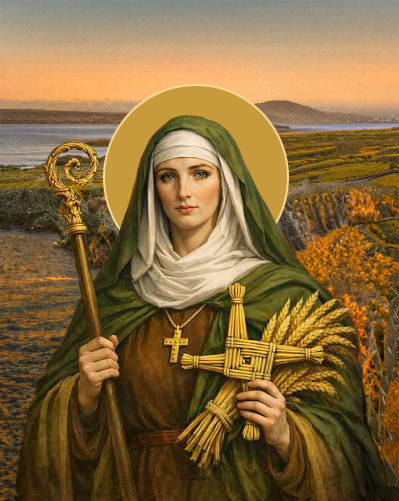
Saint Patrick is often depicted holding a shamrock, or with snakes fleeing from him. He used the shamrock to illustrate the doctrine of the Holy Trinity. Its three leaves growing out of a single stem helped him to explain the concept of one God in three Persons. Many people now regard the story of Saint Patrick driving all the snakes out of Ireland as having no historical basis.
Miracles
The pivotal event in St. Patrick’s ministry occurred in the spring of 433. He was determined to win the support of High King Laoghaire, the powerful ruler of central Ireland, whose blessing would open doors for him everywhere. His resolve to gain the king’s support precipitated a dramatic confrontation with leading druids. Patrick’s triumph over them in a contest of spiritual power versus magic secured the success of his mission at its outset.

It happened on the night before Easter. Laoghaire was celebrating a pagan festival at Tara, his base in central Ireland. By law no one in the land was permitted to kindle a fire until the ceremonial beacon of Royal Hill was lit. Miles away atop the Hill of Slane, Patrick had gathered his followers for the Easter Vigil. Unaware of the prohibition against fires, Patrick opened the liturgy by striking the new fire, the vivid symbol of Christ’s resurrection. Had he know of the prohibition, he probably would have ignored it anyway.

"King Laoghaire, his barons and the druids saw Patrick’s paschal fire and were enraged. The druids, sensing imminent danger, warned the king that he must extinguish the fire immediately. If not, said one prophetically, “it will never be extinguished in Ireland. Moreover, it will outshine all the fires we light. And he who has kindled it will conquer us all.” So the king and eight chariots full of warriors headed for Patrick’s camp."
Upon arrival the king summoned Patrick and demanded an explanation. Patrick responded with a simple summary of the gospel. When Drochu, a leading druid, made fun of Christian mysteries, Patrick prayed aloud that he be punished. With that, Drochu was swooped high into the air and dropped to his death. The warriors then attempted to capture Patrick, but he prayed they would be scattered. A dark cloud and a whirlwind descended on them, causing a panic in which many perished.
The king cowered at this demonstration of might. In his fright, he made a pretense of acknowledging God and invited Patrick to speak about the Christian faith to his barons at Tara. Then he left Slane, planning to lie in wait to ambush Patrick and his associates. When Patrick and his band passed by, however, they were invisible to Laoghaire and his would-be assassins. As the Christians escaped, they chanted for the first time the saint’s famous Breastplate. The prayer calls upon the power of the Trinity, the Incarnation, the angels, and all of heaven against every conceivable danger. In the following years, Patrick would pray it often.
On Easter Day, King Laoghaire held a banquet at Tar as part of the pagan religious festival. Patrick and five companions mystified the gathering by passing through locked doors and appearing in their midst. Invited to sit near the king, Patrick was then given a drink that Lucat-Mael, the chief druid, had laced with poison. Discerning the mischief, Patrick made a sign of the cross over the cup, and the beverage froze, except for the drop of poison. Everyone watched as Patrick poured it on the table. He blessed the cup again, and his drink returned to normal.
After his humiliation before his peers, Lucat-Mael sought to redeem himself. He challenged Patrick to a public contest of wonders on the plain of Tara, where many Irish could watch. Firs the druid is said to have magically filled the plain with waist-high snow.
“We see the snow,” said Patrick. “Now remove it.”
“I cannot until tomorrow,” said the druid.
“Then, you are powerful for evil, but not for good. Not so with me,” said Patrick. He stretched out his hands, once again carving a cross in the air. Instantly, the snow disappeared without a trace. The crowd cheered.
For his next magical stunt, the druid shrouded the plain in total darkness. Once again he was unable to reverse his trick until the next day. Patrick prayed and with a blessing dismissed the darkness. This time, the onlookers erupted with praise for Patrick’s God.
To settle the issue once and for all, Patrick proposed the third contest, a trial by fire. The druid, covered by Patrick’s cloak, would be locked in a hut made of freshly sawed wood. Benignus, Patrick’s young disciple, would be clothed in Lucat-Mael’s cloak and placed in a hut of dry wood. Then both huts would be burned to the ground. All accepted the terms, and with the two men in place, the huts were torched. This test had a marvelous outcome. Flames consumed the hut of new wood and the druid, but Patrick’s cloak was not even singed. Benignus and his hut remained untouched by the fire, but Lucat-Mael’s cloak was burned to ashes."
Patrick’s miraculous encounters with the druids were so spectacular that modern historians discount them as legends. But as extraordinary as the miracles were, the earliest documents reported them as facts. Patrick’s wonders set the stage for the conversion of Ireland. Why should he not have expected divine interventions at such significant moments in his missionary venture?
Even though Patrick had exposed the emptiness of Laoghaire’s religion, the ruler did not become a Christian. He made two decisions, however, that significantly advanced Patrick’s work. He gave Patrick permission to preach the gospel in Ireland, and he ensured Patrick’s personal safety.
From that time, Patrick crisscrossed the island, making disciples everywhere he went. In a relatively short time, he baptized tens of thousands of converts and built hundreds of churches, staffing them with Irish priests and deacons. He founded many monasteries and schools to care for the passionate youths who decided to follow him to Christ. In 444, scarcely a dozen years after Patrick arrived, he established Ireland’s first cathedral church at Armagh, which quickly became a center of Christian education and church administration.
The story of Saint Patrick and the Shamrock
Shamrock, the emblem synonymous with Saint Patrick, has a very long and colourful tradition. It means many things to different people and can evoke messages relating to national pride, religion, history, celebration etc. In horticultural terms what is Shamrock and why Irish wear it on St. Patrick’s Day?

Shamrock, Seamóg or Seamair Óg, the Irish for a young clover can be found growing wild throughout Ireland. It is worn on the feast day of St. Patrick, 17th March, to represent a link with Saint Patrick, the Bishop who spread the Christian message in Ireland. It is said Saint Patrick used the three leaved Shamrock to explain the concept of the Holy Trinity, (the Father, Son and Holy Spirit), to the pagan Irish during the 5th Century. The tradition of wearing Shamrock on Saint Patrick’s Day can be traced back to the early 1700’s.
Written works
Two Latin works survive which are generally accepted as having been written by St. Patrick: the Declaration (Latin: Confessio) and the Letter to the soldiers of Coroticus (Latin: Epistola) from which come the only generally accepted details of his life.
In it he denounces the attack of Coroticus’ men on one of his congregations.
The Breastplate (Lorica) is also attributed to Saint Patrick.
Here is the story and the beautiful words of the St. Patrick’s Breastplate prayer.
In his writings, we can see Saint Patrick’s awareness that he had been called by God, as well as his determination and modesty in undertaking his missionary work.
He refers to himself as “a sinner,” “the most ignorant and of least account,” and as someone who was “despised by many.” He ascribes his success to God, rather than to his own talents: “I owe it to God’s grace that through me so many people should be born again to Him.”
The Declaration is the more biographical of the two. In it, Patrick gives a short account of his life and his mission.
His repose
Saint Patrick died on March 17, 461 (some say 492). There are various accounts of his last days, but they are mostly legendary. Muirchu says that no one knows the place where Saint Patrick is buried.
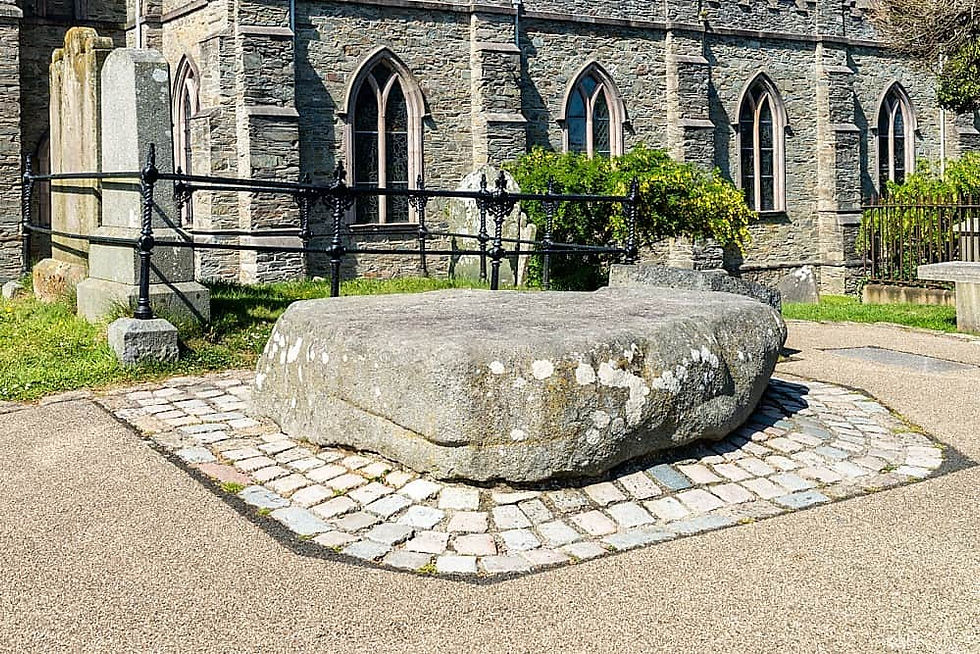
Saint Columba of Iona (June 9) says that the Holy Spirit revealed to him that Patrick was buried at Saul, the site of his first church. A granite slab was placed at his traditional grave site in Downpatrick in 1899.

Commemorated on March 17
Troparion
Troparion — Tone 3
Holy Bishop Patrick, / faithful shepherd of Christ’s royal flock, / you filled Ireland with the radiance of the Gospel: / The mighty strength of the Trinity! / Now that you stand before the Savior, / pray that He may preserve us in faith and love!
Kontakion — Tone 4
From slavery you escaped to freedom in Christ’s service: / He sent you to deliver Ireland from the devil’s bondage. / You planted the Word of the Gospel in pagan hearts. / In your journeys and hardships you rivaled the Apostle Paul! / Having received the reward for your labors in heaven, / never cease to pray for the flock you have gathered on earth, / Holy bishop Patrick!
Kontakion — Tone 8
(Podoben: “O Victorious leader...”)Let us come together joyously to praise the luminary of Ireland, / the most brilliant emulator and equal of the Apostles; / for having found boldness before the Lord, / he beseeches Him to free from all their sorrows those who cry out: “Rejoice, Father Patrick.”
Sources: www.oca.org , orthodoxroad.com , wikipedia


Comments