
St Brendan the Navigator, one of the ‘Twelve Apostles of Ireland’
- Aug 6
- 14 min read
Updated: 4 days ago

Shall I abandon, O King of mysteries, the soft comforts of home?
Shall I turn my back on my native land, and turn my face towards the sea?
Shall I put myself wholly at Thy mercy, without silver, without a horse, without fame, without honour?
O King of the Glorious Heaven, shall I go of my own choice upon the sea?
O Christ, wilt Thou help me on the wild waves?
- Prayer of St. Brendan the Voyager
"Our venerable and God-bearing father Brendan the Navigator or also known as the “Voyager”, is one of the greatest ascetics who lived in Ireland. He was perhaps the first Orthodox Christian to set foot on Canadian soil, and as such, is the first of the saints to set foot in North America."
Unfortunately, his oldest and most authentic hagiographies have been destroyed, leaving only later twelfth-century Latin and Irish manuscripts, annals and genealogies, traditions and tales; he is also referenced in the Lives of several other Irish saints. But, most importantly, he has been revered and venerated by the Irish for generations as one of the country's most prominent Church figures.
The earliest mention of Brendan is in the Vita Sancti Columbae (Life of Saint Columba) of Adamnán written between AD 679 and 704. The earliest mention of him as a seafarer appears in the Martyrology of Tallaght of the ninth century. The principal works regarding Brendan and his legend are a "Life of Brendan" in several Latin (Vita Brendani) and Irish versions (Betha Brenainn) and the better known Navigatio Sancti Brendani Abbatis (Voyage of Saint Brendan the Abbot)

His Early Life
He was born in 484 or 486, and according to several stories, he died in 575, 577, or 583 at the age of over 100. His parents’ names were Finnlug and Cara. The future saint was most likely born on small Fenit Island, northwest of the fishing village of Fenit in County Kerry, six miles from Tralee in Ireland's far southwest.
According to the tradition, St. Brendan was baptised as an infant by the holy Bishop Erc of Slane.
The night Brendan was born,

Bishop Erc witnessed an astonishing light and a chorus of angels in dazzling robes descend from heaven over his parents' house.

Tobar na Moult holy well, where St. Brendan was baptised, is located near Tralee and Ardfert, and is still open to visitors seeking healing and relief. A chapel at this well contains an altar with figures of three saints (Sts. Brendan, Erc, and Ita).
Brendan was given to St. Erc at the age of two to the care of the illustrious
holy Abbess Ita (c. 570; feast: January 15) of Killeedy in Limerick, known as "the Foster-mother of the Irish Saints."
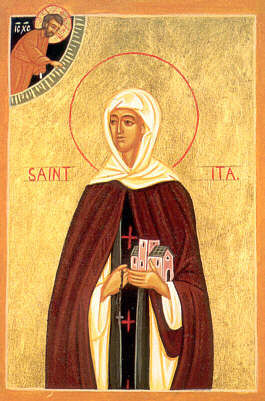
"Under St. Ita, Brendan studied the rudiments of Christianity for five years, and he retained the love and respect for the abbess who nurtured and among other things taught him, that God really loves: "the true faith of a pure heart; the simple religious life; and bountifulness inspired by Christian charity." She might have added that the three things God hates are "a scowling face; obstinate wrongdoing; and too much confidence in money." "
When he was six years old he was sent to Saint Jarlath's (c. 540; feast: June 6) monastery school at Tuam to further his education. St. Brendan was also a disciple of St. Enda of Inishmore (+ c. 530; feast day: March 21), one of Ireland's first monastic founders.
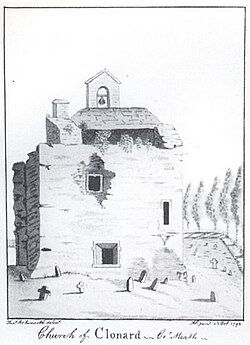
During that period our saint visited Clonard Monastery in County Meath

alongside St. Finnian († 549; feast: December 12), often known as "the Teacher of the Irish Saints" or a successor. Notably, St. Brendan the Navigator (like his saintly counterpart, St. Brendan of Birr in Offaly, who died in c. 573 and is commemorated on November 29) is one of "the Twelve Apostles of Ireland," all of whom lived in Clonard. Finally, according to tradition, the young saint travelled to Wales and spent time with St. Gildas (or St. Cadoc) at Llancarfan in Glamorgan, a monastery known for its learning. The mediaeval Irish and Welsh monastic traditions were inextricably linked.
His Mission
After being trained by such great monastic saints, St. Brendan was tonsured a monk, ordained (it is believed by St Erc himself), and then proceeded to the west of his native Ireland to construct churches, undertake substantial missionary work, and shepherd his people. All of his biographers said that St. Brendan lived an austere monastic life and rose to prominence as a miracle worker. He demonstrated exceptional enthusiasm for prayer, rigorous abstinence, profound humility, and immense mercy and love for everybody.

"Saint Brendan's first voyage was to the Aran Islands, where he founded a monastery. Like his master Saint Jarlath, he established churches in Brittany on the northern coast of France, and in Wales. St. Brendan founded numerous monasteries in Ireland and Scotland, where he travelled frequently. By establishing so many monasteries, he became known as the Apostle of Ireland. "

Clonfert, on the west bank of the Shannon River in County Galway, was the most well-known of them, having been founded around 559. St. Brendan established Clonfert, which became well-known across Ireland. It was once home to over 3,000 monks, who eventually became missionaries and journeyed throughout Europe to preach the Gospel. St. Fursey (c. 648; feast: January 16), a student of Clonfert, may have received instruction from St. Brendan in his childhood. He later established monasteries in Eastern England and France.

St. Brendan also founded the monastery and diocese of Ardfert, which grew into a major ecclesiastical and monastic center in Kerry near the saint's birthplace. Then he established a settlement in Inis-da-druim, presently known as Coney Island (Innisdadrom), County Clare. Following that, he established a monastery in Annaghdown, County Galway, near the Bay of Annaghdown and Lough Corrib.
According to numerous stories, St. Brendan was also active in the historical Irish province of Leinster, where he is associated with a number of sites. Let us note the parishes of Disart in County Kilkenny, Killeney (which still has a church dedicated to St. Brendan), and Brandon Hill in Kilkenny.

Brandon Hill, named for St. Brendan, is the tallest mountain in County Kilkenny, standing at approximately 1700 feet. St. Brendan established a monastic community or church nearby.
Later St. Brendan establishments worth mentioning include a monastery on the island of Inchiquin, also known as Innisquin, in the parish of Killursa in Galway, and a monastic community on Inishglora, off the Mullet Peninsula in County Mayo. For the past century, this island has remained uninhabited. Inishglora is known for holding some of his relics. It is possible that two monastic communities, one for monks and one for nuns, operated here at the same time. Today, you may visit the remnants of the early St. Brendan's Church, a "church for men," and a "church for women," as well as sip water from St. Brendan's holy spring, which was used by local monks in the first millennium. There are extremely ancient cross shafts and other relics beside the remnants of three early beehive cells, one of which belonged to St. Brendan.

"Legends of Inishglora abound. In the late twelfth century, historian Gerald of Wales testified that as long as monks lived on this island, human corpses were not buried or decayed on it—many bodies were deposited in the open so that people could see their ancestors absolutely uncorrupt for generations (this phenomenon must have ended when the monks left). The same historian claimed that as long as prayer was performed on Inishglora, pests such as mice and rats
would never live there. Thousands of them swarmed other Irish islands, yet not a single one was discovered. When someone brought a rodent to Inishglora, it would immediately flee and leap into the sea, or perish if it was stopped. Previously, all ships passing by Inishglora would drop their top sails in honour of St. Brendan, whose wonderworking wooden statue could be found within St. Brendan's Church. The garlic that grows on Inishglora now is claimed to have been cultivated by monks 1500 years ago!"
The majority of St. Brendan's life was spent on trips and voyages (as is common for Irish monks and ascetics), which is why he was later nicknamed the "Navigator". An Irish monk produced the legendary saga Navigatio Sancti Brendani (The Voyage of St. Brendan) in the eighth and ninth centuries, after which other authors wrote more detailed versions. Though famous throughout the Middle Ages, this narrative converted the actual seafaring hermit and abbot into a semi-mythical adventurer with superhuman skills who performed incredible feats. It states that when Brendan was abbot of Clonfert, a monk named Barrindus1 paid him a visit. The monk told him that he had travelled through a dense fog to the "heavenly Jerusalem" filled of valuable stones, where the sun never set, there were many mountains, birds sang sweetly, a river ran from east to west, and all the vegetation were in blossom. Barrindus had spent a year there.

After hearing his story, Brendan gathered fourteen disciples from his community, returned to Kerry.
"On the Kerry coast, he built a coracle of wattle, a homemade wooden boat covered in oxide, covering it with hides, and rigged a mast and a sail. After praying on the shore, he went forth to extend the Kingdom of God on earth. Their food and water supply would last forty days, but they were doomed to travel the ocean for seven years."

This was an act of faith in which these monks, similar to the ascetics of the Egyptian desert, abandoned their comforts and set sail toward no specific destination. They relied - absolutely trusted - in the destination God had chosen for them, whether it was a perilous journey, a distant beach, or death at sea.
This particular type of self-imposed discipline, unique to the Orthodox Celts but shared in spirit with the deserts of Egypt, the forests of Russia, and the mountains of Greece and Serbia, was a summons for only a few souls out of thousands. However, the same spirit of entire reliance on God, and the commitment to set Christ at the center of every decision, is not unique to the Orthodox Celts or monastics; it is integral to the life of every authentically Orthodox Christian.
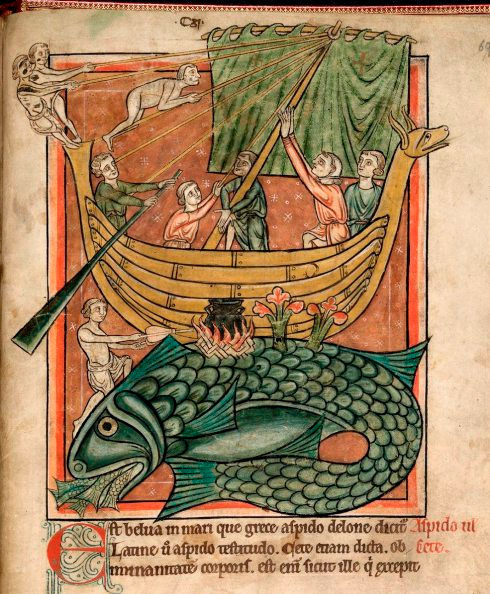
In all versions of the narrative, St. Brendan and a group of fellow monks searched the Atlantic Ocean for the "Promised Island of Paradise". They eventually found it and spent some time there, encountering many interesting, exciting, and perilous situations. Throughout the voyage, their routine consisted of the regular monastery cycle of worship and labour, with each day punctuated by monastic obligations 'in the field'. After spending some time on the "Promised Island" of saints, St. Brendan gathered some of its celestial fruit and valuable stones before sailing back.
According to modern researchers, the saga was influenced by early Christian apocryphal literature, Irish (and Scandinavian) mythology, as well as the authors' fancies and historical truths. This work was preserved in 116 Mediaeval Latin manuscripts, as well as variants in Middle English, German, French, Flemish, Italian, Norse, and Provencal. This amusing and captivating narrative, which has been translated into many modern languages and published all over the world, contains enlightening elements and is still popular today.
St. Brendan and his companions are said to have made a seven-year voyage across the Atlantic to the west of their ancestral land, returning to the same islands on key Church feast days every year to serve the Liturgy. However, the goal of their trips was to pray to God constantly (as an ascetic discipline; in this case, the ocean acted as their "desert"), build churches and chapels, convert insular residents, and most likely propagate Irish manuscripts and other talents. It is likely that these missionaries arrived in North and Central America, Greenland and Newfoundland, or perhaps South America and the Canary Islands, some 1000 years before Christopher Columbus.
What is certain, however, is that St. Brendan sailed to the Hebrides (where he founded at least two monasteries: on Tiree and Eileach an Naoimh, where very early monastic ruins survive), Orkney, Shetland (all of them in Scotland), mainland Scotland (where he founded at least one monastic community on its west coast and had a memorable meeting with St. Columba of Iona), the Faeroes (now belonging to Denmark), Iceland (where he is remembered in some traditions), Wales

In the 1970s, a team of explorers led by Tim Severin (b. 1940) built a 36-foot replica of the Irish currach (an open boat of ash and oak lashed together with about two miles of leather thong), sailed from the Irish coast, and eventually reached Newfoundland, making several stops along the way, proving that St Brendan in the sixth century could do the same! Furthermore, during their voyage, Severin's crew identified some "mystical" objects described in the mediaeval saga, such as "the island of sheep," "the Paradise of birds that sung spiritual hymns" (possibly both on the Faeroes), "crystal towers" (glaciers and icebergs on the northern islands), "the mountains that hurled rocks" (volcanoes in Iceland), "sea monsters" (whales, porpoises, and probably walruses), etc. It is hardly surprising that Christopher Columbus believed St. Brendan had discovered America before him, and that he (Columbus) relied on charts based in part on St. Brendan's voyages.
Let us mention an excerpt from Novice Vsevolod's (Filipiev's) work, An Athonite. A Story and Parable (Palomnik Publishing House, 2014), translated from Russian:
"There is evidence that Christian ascetics discovered America long before Columbus. In ancient times, there were'monastery-ships' that travelled long distances. According to one version, those austere ascetics sought out the most remote and inaccessible locations possible, where they might devote themselves entirely to prayer and repentance. Obviously, it was the seafaring monks who brought the aforementioned ascetics to America, which was still unknown in the Old World. The location of that place was kept top secret by the voyager-monks who returned to Europe in order not to reveal the anchorites."
It's unclear what happened to the earliest Christian hermits in America, if they ever went. It is likely that when they landed, they had no idea where Native Americans resided. Did they have to make touch with Indians, or did the Lord keep them hidden among pristine American nature and the unspoiled desert till the end of their lives? Whatever the case, it is argued that they left the rock Church calendar computations, which clearly date back to the age following Christ's birth."
Interestingly, Archpriest Alexander Shabanov, who serves at the churches of the Protecting Veil of the Mother of God and St. Arseny of Tver in Tver, Russia, has dedicated some of his writings to the pre-schism saints of the British Isles and Ireland, especially St. Brendan the Voyager. In his works, "St. Brendan the Navigator, in Quest of the Promised Island" and "Boats to St. Brendan" (both in Russian), he conducted extensive research into the "Navigatio" from multiple perspectives, attempting to trace elements of truth and fiction as well as the various influences of mediaeval sagas on St. Brendan's voyages. At the end of his work, he speculates that St. Brendan and his companions/followers may have trekked through Scandinavia and the Baltic, eventually reaching the Kola Peninsula and visiting various locations in what is now northwestern Russia, particularly the districts near Ladoga Lake, Lake Ilmen, and the Volkhov River. He goes on to speculate that the Baptism of Russia was not without the participation of Celts (the Irish), who may have built some churches and erected Celtic "standing crosses" in the aforementioned areas, as well as in Novgorod and Kiev (he claims that the first monastery in Kiev until the eleventh century was Irish!). Though there is little evidence to support this, some contemporary historians believe that individual Irish missionaries may have trekked as far east as Russia's north. It's not impossible.
"J. Le Goff estimates that over the period of 200 years, Ireland "exported" roughly 115 holy men to Germany (where St. Brendan was worshipped in several monasteries), 45 saints to France, 44 to Britain, 36 to what is now Belgium, 25 to Scotland, and 13 to Italy. The majority of these saintly figures are legendary and have become part of the countries' mythology, demonstrating how deeply Irish monasticism influenced the Western world's mentality and sensibilities."
Let us name a few saints who were followers of St. Brendan. These were: St. Colman of Cloyne (c. 522-600; feast: November 24), who in his youth was a royal bard at Cashel, baptised by St. Brendan, and was later ordained and preached in the Limerick and Cork regions of Ireland, founding the cathedral of Cloyne ("meadow of the caves") in c. 560 and becoming its first bishop (the mediaeval Anglican Cathedral in Cloyne, co. Cork, and the contemporary RC Cathedral in Cobh are dedicated to him); St. Finan of Kinitty (the sixth century;
His Repose
St. Brendan the Navigator died peacefully in Annaghdown and was buried in Clonfert Monastery, where he had served as abbot for many years. Later his remnants were interred at Clonfert Cathedral where they may rest to this day, however the exact location is unknown. Even during his lifetime, everyone liked St. Brendan, and after his death, he was widely venerated throughout Ireland, Scotland, Wales, and Brittany. He is recorded in all of the great Irish martyrologies, and his worship spread to England, Iceland, and many other parts of the continent. Seamen and travelers have always invoked the name of St. Brendan in their prayers. Numerous churches and chapels in coastal settlements of Ireland and Scotland were dedicated to him, and several are still operational.
St. Brendan is commemorated in numerous places, particularly on Ireland's west coast. Among these are Brendan Bay, Brendan Point, Brendan Well, Brendan Head, and Brendan Creek.
St. Brendan of Clonfert is also revered as the patron saint of the Dingle Peninsula in County Kerry, which includes Ireland's westernmost tip and all of Europe. Brandon Creek (a small bay) is located precisely on the Dingle Peninsula, and according to legend, it was from here that St. Brendan set sail with his crew on the seven-year voyage across the Atlantic to America!

To commemorate St. Brendan, a large bronze statue of him was erected on neighbouring Great Samphire Island at the entrance to Fenit Harbour in the 2000s.
Mount Brandon, located just east of this watercourse, is already the second (and more well-known) mountain associated with our saint! Every August, Catholic and Orthodox pilgrims visit the location, which is named for him. It is the principal sacred site on the Dingle Peninsula, and has been revered since around 800. It is situated near the saint's birthplace. The mountain stands more than 3,100 feet tall, giving it the country's ninth highest peak. According to legend, St. Brendan prayed on its top for three days before leaving for America and had a vision of angels there. Some locals believe that their revered saint's grave lies on the summit. Indeed, an ancient stone edifice barely wider than a coffin still stands there. Mist often covers the peak top. The mountain sits at the very end of the old Christian pilgrimage destination known as "The Saints' Road".

"St. Brendan the Navigator is usually depicted as a monk or a priest celebrating a service on a ship, while fish gather around to listen to him; with a whale (in one version of the “Navigatio” the monks found themselves on the back of a giant whale, and celebrated the Paschal Liturgy there without noticing where exactly they were); or in the same boat with fellow-monks. "
Thanks to St. Brendan’s extraordinary spiritual practice of praying unceasingly at sea while navigating for many miles on the open ocean in a humble vessel, covering great distances and putting all his hope in God’s mercy and protection, visiting and discovering many lands, in Russia the modern Russian priest and world-famous traveler Fr. Fyodor Konyukhov has been compared to him.
“Brendan” and similar forms of the name is still a popular baptismal name in Ireland and other countries with significant Irish communities, including among the Orthodox. An OCA missionary parish in Astoria, Oregon, is dedicated to St. Brendan.
Holy Father Brendan the Navigator, pray to God for us!

He is commemorated by the Church on May 16.
Troparion
Troparion (Tone 8)
The image of God was truly preserved in you, O Father, / for you took up the Cross and followed after Christ. / By so doing you taught us to disregard the flesh for it passes away / but to care instead for the soul, since it is immortal. / Therefore, O Venerable Brendan, your spirit rejoices with the Angels.
Kontakion (Tone 2)
Having divinely armed yourself with purity of soul / and firmly grasping unceasing prayer as a spear, you have slain the armies of the demons. / Therefore, we beseech you, O Father Brendan: / “Always intercede for those who honour you.”
Sources: orthochristian.com , orthodoxcanada.com , orthodoxwiki.org , oca.org , Wikipedia


Comments