
St Alban, Protomartyr of Britain
- Jul 23
- 5 min read
Updated: 3 days ago
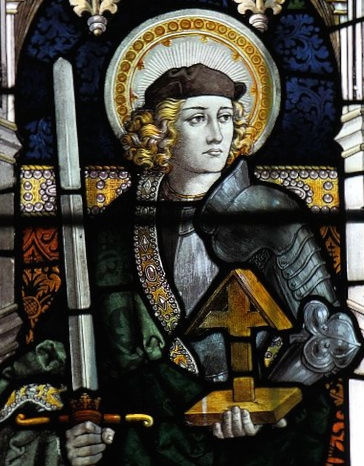
Saint Alban (/ˈɔːlbən, ˈæl-/; Latin: Albanus) is venerated as the first-recorded British Christian martyr, for which reason he is considered to be the protomartyr of Britain. Along with fellow Saints Julius and Aaron, Alban is one of three named martyrs recorded at an early date from Roman Britain (Amphibalus was the name given much later to the priest he was said to have been protecting). He is traditionally believed to have been beheaded sometime during the 3rd or 4th century, and has been celebrated there since ancient times.
His Martyrdom
Bede's account
One of the best known accounts is that of Bede's Ecclesiastical History of the English People, written in 731. In the 3rd or 4th century, Christians began to suffer cruel persecution. However, Gildas says he crossed the Thames before his martyrdom, so some authors place his residence and martyrdom in or near Londinium.
He was a Roman citizen residing in Verulamium (present-day Saint Albans), situated several miles northwest of London, during an era of persecution. He was probably held military rank, privileged with Roman citizenship in the same way as was the Jew, St. Paul of Tarsus…”

Whilst this persecution was raging, St. Alban, was still a pagan. Nevertheless, when the priest Amphibalus sought his help he freely gave it. The holy priest was being pursued by the persecutors and Alban gave him a hiding place. Alban was struck by the priest's unwavering devotion and watchfulness, prompting him to enquire of Amphibalus regarding his convictions. Consequently, Alban found faith in Christ and requested baptism.
Ultimately, Amphibalus was compelled to depart, and Alban exchanged garments with him to facilitate his escape. The troops learned of a clergyman concealed within Alban's residence, prompting them to conduct a search. Observing Alban attired in the clerical garments, they apprehended him and presented him to the magistrate.
The magistrate was performing a sacrifice to deities when Saint Alban presented. Upon interrogation, he exposed the manner in which Alban and the clergyman had exchanged garments. Enraged by Alban's aiding of a fugitive's escape, the magistrate charged him with execution unless he renounced Christianity and disclosed Amphibalus's whereabouts. Saint Alban responded, “I too am a Christian, and I venerate the one and true God.”
"Alban was led to execution, and he presently came to a fast-flowing river that could not be crossed (believed to be the River Ver). There was a bridge, but a mob of curious townspeople who wished to watch the execution had so clogged the bridge that the execution party could not cross. Filled with an ardent desire to arrive quickly at martyrdom, Alban raised his eyes to heaven, and the river dried up, allowing Alban and his captors to cross over on dry land. The astonished executioner cast down his sword and fell at Alban's feet, moved by divine inspiration and praying that he might either suffer with Alban or be executed for him."
The other executioners hesitated to pick up his sword, and meanwhile, Alban and they went about 500 paces to a gently sloping hill, completely covered with all kinds of wildflowers, and overlooking a beautiful plain. (Bede observes that it was a fittingly beautiful place to be enriched and sanctified by a martyr's blood.)

When Alban reached the summit of the hill, he began to thirst and prayed God would give him water. A spring immediately sprang up at his feet. It was there that his head was struck off, as well as the head of the first Roman soldier who was miraculously converted and refused to execute him. However, immediately after delivering the fatal stroke, the eyes of the second executioner popped out of his head and dropped to the ground, along with Alban's head, so that this second executioner could not rejoice over Alban's death.
The exact date of Saint Alban's martyrdom remains ambiguous, though it is thought to have

occurred during the rule of Decius (circa 251) or Valerian (circa 257). The Turin manuscript from the eighteenth century, potentially derived from a fifth-century source, indicates that Saint Alban might have been executed as early as 209, during the reign of Emperor Septimus Severus and his two sons in Britain.
The identity of the converted executioner remains unrecorded. The cleric Amphibalus was eventually apprehended and executed at a location known as Redbourn, situated four miles from Verulamium.
When the populace started to protest against the magistrate, he ceased the oppression. Subsequent years saw the construction of a cathedral at the location of the martyrdom, where the relics of Saint Alban, the priest Amphibalus, and possibly the executioner were enshrined. Saint Bede (May 27) informs us that miraculous events often occurred at the tomb of Saint Alban. In 860, when the Danes assaulted England, the relics were secured for protection and subsequently restored.

"A new chapel and shrine were constructed for the relics in the early fourteenth century. Two centuries later, amid the dissolution of the monasteries under Henry VIII, the marble shrine was obliterated. Eventually, the remnants of the shrine were reconstructed at its original location. The fate of the relics remains ambiguous, yet it is likely that they were either obliterated or interred in an unmarked location."
Despite occasional portrayals of Saint Alban in military attire, there is no substantiation of his status as a soldier. Ultimately, he was residing in a private residence at the time of his apprehension, rather than in a military barracks. A mediaeval artwork is located in the southern aisle adjacent to the Choir in the Abbey, illustrating Saint Alban with crimson hair. A mediaeval seal, currently housed in the
Durham Cathedral Chapter Library, depicts him sporting a robust beard. He possesses a stocky build, characterised by a prominent, rounded, and receding hairline, while a cloak drapes over his left side and right shoulder.
Commemorated on June 22
Troparion

Troparion — Tone 4
In his struggle your holy martyr Alban, / gained the crown of life, O Christ our God. / For strengthened by you and in purity of heart, / he spoke boldly before the judges of this world, / offering up his head to you, the Judge of all!
Kontakion — Tone 2
(Podoben: “You sought the heights...”)You appeared as a bright star announcing Christ with your radiance, / which is repulsive to this world, O Martyr Alban; / extinguishing the allure of false gods, / you enlighten the faithful, / always interceding for us all.


Comments