
Saint Gildas the Wise of Wales, Abbot of Rhuys
- Jul 25
- 9 min read
Updated: 3 days ago

St Gildas (English pronunciation: /ˈɡɪldəs/, Breton: Gweltaz; c. 450/500 – c. 570)[a][b] – also known as Gildas Badonicus, Gildas fab Caw (in Middle Welsh texts and antiquarian works) and Gildas Sapiens (Gildas the Wise) – was a 6th-century British monk best known for his religious polemic De Excidio et Conquestu Britanniae, which recounts the history of the Britons before and during the coming of the Saxons. He is one of the best-documented figures of the Christian church in the British Isles during the sub-Roman period, and was renowned for his Biblical knowledge and literary style. In his later life, he emigrated to Brittany, where he founded a monastery known as Saint-Gildas-de-Rhuys.
"He was born in the year when the Britons defeated the Saxons at the battle of Mount Badon (most scholars presume that this took place in the 490s near the city of Bath in Somerset). There are two Lives of St. Gildas, written in the ninth and twelfth centuries by an anonymous monk of Rhuys and the Welsh cleric Caradoc of Llancarfan respectively."
According to the most popular version, the future saint was born in Scotland, in what is now Dumbarton on the banks of the River Clyde, but according to another version, his birthplace was in North Wales. Gildas was descended from a wealthy British family. In his youth St. Gildas was married but was later widowed. The saint became a close disciple of St. Illtyd in South Wales in his famous Llanilltud Fawr Monastery in the Vale of Glamorgan, and it was there that Gildas was tonsured a monk. Such great saints as Sts. Samson and Paul Aurelian may have studied in Llanilltud together with him.
After Wales Gildas most probably continued his spiritual education and gained experience in Ireland where, specifically, he lived and preached in Armagh. On the Emerald Island he was ordained a priest. After Ireland the saint travelled to “the north of Britain” (that is, North Wales) where he zealously evangelized and performed many miracles.

St. Gildas is regarded as one of the principal apostles of the Orthodox faith and early preachers of Wales, though very scarce details of his activities in the region survive.
"He was one of the most influential fathers of Welsh monasticism in the sixth century. Some biographers even attribute to him the composition of a monastic rule. "
One of the spiritual companions of Gildas was St. David of Mynyw, the patron-saint of Wales. Gildas most likely visited Ireland again about the year 565, where he preached the Gospel, built many churches and monasteries. The influence of this saint in Ireland was very strong and numerous Irish monks and ascetics were among his disciples. It is possible that for some time Gildas lived as hermit on Flatholm

– an island in the Bristol Channel, situated off the coast of Cardiff in Wales. A number of other ancient ascetics of South Wales used to live on this island as well. It is quite possible that the holy man made a pilgrimage to Rome on one occasion.
In the final stage of his life, Gildas moved to Brittany where he lived as anchorite on the isle known as Ile-d’Houat, devoting his time to prayer, abstinence and writing spiritual books. On the neighboring Rhuys Peninsula (now in the Morbihan departement, not far from Vannes) he founded a monastery and became its first abbot. The local people learned about the ascetic and soon believers came to love him, starting to visit his monastery continuously. The man of God reposed peacefully in Brittany around the year 570. It is known that the fame and influence of this saint spread all over Brittany, Wales, and Ireland as well as other countries. Gildas corresponded with monks from many monasteries in foreign countries. St. Gildas was eventually nicknamed “Gildas the Wise” for his learning and his numerous literary works. As was the case with other Celtic ascetics, the personal bell of Gildas was famous.
Gildas is noted not only as a prominent ascetic, preacher, founder of monasteries and teacher of monks, but also as a spiritual author. He was an outstanding historian and chronicler of the Britons, and his main work is De Excidio et Conquestu Britanniae (“On the Ruin and Conquest of Britain”), was written in c.540. In this work Gildas strictly reproaches his compatriots the Britons, for whose sins Britain was attacked and invaded by Angles and Saxons. In this book the saint gives an account of British history from the Roman period until his own time (which makes him an invaluable source), describing the corruption and decline of faith among many of his contemporaries, including rulers and clerics. Later this book was cited by such distinguished historians as St. Bede of Jarrow and the learned monk Alcuin. The writings of Gildas reflect his profound knowledge of the Holy Scriptures, works of some authors of antiquity (for example, Virgil) and even books of Church Fathers of East and West, like St. Ignatius the God-Bearer of Antioch and St. John Cassian. But first of all, a holy man with a high level of culture is seen in his texts. Unfortunately, almost nothing survives of the literary works of Gildas, except for De Excidio, but they enjoyed great popularity in Wales, England and Ireland for many centuries.

Sited in the hamlet of St Gildas (in the Commune of Guisseny), this spring/fountain is one of several in Brittany dedicated to the Celtic St Gildas. Gildas spent 10 years in Brittany, and he is the 'rain saint' of Brittany, just as St Cewydd was in Wales before the Saxons transferred this tradition to St Swithun. (Source: The Book of Welsh Saints). The hamlet contains a former Priory (now a private house), as well as a medieval stone cross and some small menhirs of unconfirmed antiquity.
There are also two interesting 'lavoirs' or communal clothes washing pools close to the well.
Today this celebrated saint is venerated in France, Wales and Ireland, but above all in Brittany. One of the main centers of his veneration is Saint-Gildas-de-Rhuys (named after him) in the Rhuys Peninsula, Morbihan, Brittany. The major relics of this saint were kept here in ancient times (and, according to later traditions, a portion of his relics was kept at Glastonbury in England where he may have labored for some time). In the eighteenth century a part of his relics was said to be preserved at Vannes Cathedral in Brittany. The wooden monastery founded by Gildas in Rhuys was rebuilt in the eleventh century in stone and the large abbey existed there more or less until the French Revolution, and the saint’s relics healed the mental diseases of numerous pilgrims. In 1796 the monastery was closed and in 1802 its church became a parish church.

Now a small Catholic convent is attached to it. Today there are the splendid Romanesque old Abbey Church of St. Gildas (possessing the stone tomb and a statue of St. Gildas among other treasures) and the holy well of St. Gildas in Saint-Gildas-de-Rhuys. There is a statue of this saint near Saint-Gildas-de-Rhuys, too. Other places in Brittany are also connected with him. Thus, a holy well in the Magoar commune, Cotes-d’Armor departement, is dedicated to him. Gildas is the patron-saint of a number of churches and monasteries across Brittany and other regions of France. A Catholic parish church in Rosneath village in Scotland (Argyll and Bute) is dedicated to St. Gildas. The library of Cambridge University preserves two manuscripts associated with him—copies of St. Gildas’ writings.
Further traditions
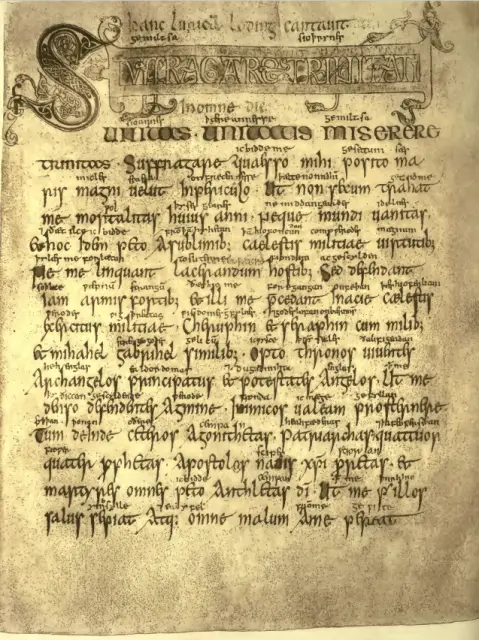
Gildas is credited with a hymn called the Lorica, or Breastplate, a prayer for deliverance from evil.
"The Lorica (Breastplate) of Gildas is also known as the Lorica of Loding, and is found in the Book of Cerne.
"Trinity in unity, preserve me. Unity in Trinity, have mercy on me.
I pray, preserve me from all dangers which overwhelm me like the waves of the sea, so that neither mortality nor the vanity of the world may sweep me away this year. And I also ask, send the high, mighty hosts of heaven, that they not abandon me to be destroyed by enemies, but defend me now with their strong shields and that the heavenly army advance before me: cherubim and seraphim by the thousands, and archangels Michael and Gabriel, likewise, I ask, send these living thrones, principalities and powers and angels, so that I may be strong, defended against the flood of strong enemies sin the next battle.
May Christ, whose terror scares away the foul throngs, make with me a strong covenant. God the unconquerable guardian, defend me on every side by your power. Free all my limbs, with your safe shield protecting each, so that the fallen demons cannot attack against my sides or pierce me with their darts.
I pray, Lord Jesus Christ, be my sure armor.
Cover me, therefore, O God, with your strong breastplate.
Cover me all in all with my five senses, so that, from my soles to the top of the head, in no member, without within, may I be sick; that, from my body, life be not cast outby plague, fever, weakness, suffering, Until, with the gift of old age from God, departing from the flesh, be free from stain, and be able to fly to the heights, and, by the mercy of God, be borne in joy to the heavenly cool retreats of his kingdom. "
Source: The Lorica of Gildas, also known as the Lorica of Loding from the Book of Cerne.
Source of this version: Prayers from the Ancient Celtic Church, © 2018, Paul C. Stratman
Note: The Lorica of Loding continues after the section above to appeal to the saints for protection, and then to pray, individually, for protection for all the parts of the body. The remainder of the Lorica is presented below, based on the translation by Hugh Williams in Gildas: The Ruin of Britain … together with the Lorica of Gildas, 1899.
"Patriarchs four, prophets four, apostles, watchmen of the ship of Christ, and all the athlete martyrs, I ask–And charge also all virgins, faithful widows, and confessors, to surround me by their safety, and every evil perish from me.
May Christ, whose terror scares away the foul throngs, make with me a strong covenant. God the unconquerable guardian, defend me on every side by your power.
Free all my limbs, with your safe shield protecting each, so that the fallen demons cannot attack against my sides, or pierce me with their darts.
Skull, head, hair and eyes, forehead, tongue, teeth and their covering,
neck, breast, side, bowels, waist, buttocks and both hands. For the crown of my head with its hair,
be the helmet of salvation on my head;
for forehead, eyes, triform brain, nose, lip, face, temple; for chin, beard, eye-brows, ears, cheeks, lower cheeks, internasal, nostrils;
for the pupils, irises, eyelashes, eyelids, chin, breathing, cheeks, jaws; for teeth, tongue, mouth, throat, uvula, windpipe, bottom of tongue, nape; for the middle of the head, for cartilage, neck—you, kind One, be near for defense. I pray, Lord Jesus Christ, by the nine orders of holy angels, Lord, be my sure armor, for my limbs, for my entrails, that you may drive back from me the invisible nails of stakes, which enemies fashion.
Cover me, therefore, O God, with strong breastplate, along with shoulder blades, shoulders and arms.
Cover my elbows and elbow-joints and hands, fists, palms, fingers with their nails.
Cover back-bone and ribs with their joints, hind-parts, back, nerves and bones.
Cover surface, blood and kidneys, haunches, buttocks with the thighs.
Cover hams, calves, thighs, knee-caps, hocks and knees.
Cover ankles, shins and heels, legs, feet with the rests of the soles.
Cover the branches that grow ten together, with the toes and their nails ten. Cover chest, sternum, the little breast, nipple, stomach, navel.
Cover belly, reins, genitals, and paunch, and vital parts also of the heart.
Cover the triangular liver and fat, spleen, armpits with covering.
Cover stomach, chest with the lungs, veins, sinews, gall-bladder with Cover flesh, groin with the inner parts, spleen with the winding intestines.
Cover bladder, fat and all the numberless orders of joints.
Cover hairs, and the rest of my limbs, whose names, may be, I have passed by.
Cover me all in all with my five senses, and with the ten doors formed for me, so that, from my soles to the top of the head, in no member, without within, may I be sick; that, from my body, life be not cast outby plague, fever, weakness, suffering, Until, with the gift of old age from God, I blot out my sins with good works; And, in departing from the flesh, be free from stain, and be able to fly to the heights, and, by the mercy of God, be borne in joy to the heavenly cool retreats of his kingdom."

St Gildas commemorated: January 29
Troparion of the saint, in 1st Tone
— Made radiant by the grace of the Spirit, O God-bearing father Gildas, in spirit thou wast shown to be an all-radiant beacon of repentance; and by thy divinely inspired discourse, O venerable one, thou didst seek to awaken those in error from the sleep of sin. Wherefore, lead us to salvation who bless thee as a wondrous servant of God.
Venerable Father Gildas the Wise, pray to God for us!
Sources: Wikipedia , orthochristian.com


Comments