
Holy Hierarch St Dyfric (Dubricius) of Wales
- Jul 25
- 9 min read
Updated: 4 days ago

St Dyfric, Dubricius or Dubric (Welsh: Dyfrig; Norman-French: Devereux; c. 465 – c. 550) was a 6th-century British ecclesiastic venerated as a saint. He was the evangelist of Ergyng (Welsh: Erging) (later Archenfield, Herefordshire) and much of south-east Wales.
Biography
"St Dubricius was the illegitimate son of Efrddyl, the daughter of King Peibio Clafrog of Ergyng. His grandfather threw his mother into the River Wye when he discovered she was pregnant, but failed to drown her. "
Dubricius was born in Madley in Herefordshire, England. He and his mother were reconciled with Peibio when the child Dubricius touched him and cured him of his leprosy.
St. Dyfrig, also known by the Latin name of Dubricius, was one of the founders of Orthodox monasticism in Wales. The influence of this great saint in the late fifth and first half of the sixth centuries was significant. No fewer than 2,000 monks lived in the monasteries established by him. Unfortunately, not much authentic information on the saint survives, and his Life, written in the twelfth century by a monk called Benedict of Gloucester, is not very reliable.
However, it can be said for certain that most of his labors for the Church were undertaken in the Welsh region of Gwent and on the territory of the present-day English county of Herefordshire. Most probably St Dyfrig was born in Madley, six miles west of Hereford in today’s Herefordshire in England (at that time part of Wales), in the mid-fifth century. According to tradition, while yet a boy Dyfrig healed his grandfather, a king, from epilepsy. From childhood the future saint was noted for his intellect and religiosity. It is possible that disciples of the holy hierarch Germanus of Auxerre, who twice visited Britain in the first half of the fifth century, had a certain influence on the saint. When St Dyfrig was a young man, he was sent to study at a monastery in Wales. His mentors considered Dyfrig to be one of the most diligent and able students. He became a theologian, and learned in various sciences and the law.
St Dyfrig is one of the greatest founding fathers of Welsh monasticism and a builder of many monastic communities. Thus, he founded monasteries at Henllan (according to one version, on the site of the Welsh village of Henllan in Denbighshire, and according to another version, in Hentland in Herefordshire) and Moccas (now a village with the same name in Herefordshire. A church of the Archangel Michael now stands on the site of that monastery). These two were his major establishments, where the holy abbot gathered many disciples, and it was from there that he built his other monasteries, cells and churches. Thus, Dyfrig also built monasteries in the valley of the River Wye and in the Archenfield district; for example, in Whitchurch he founded a monastery or a church.
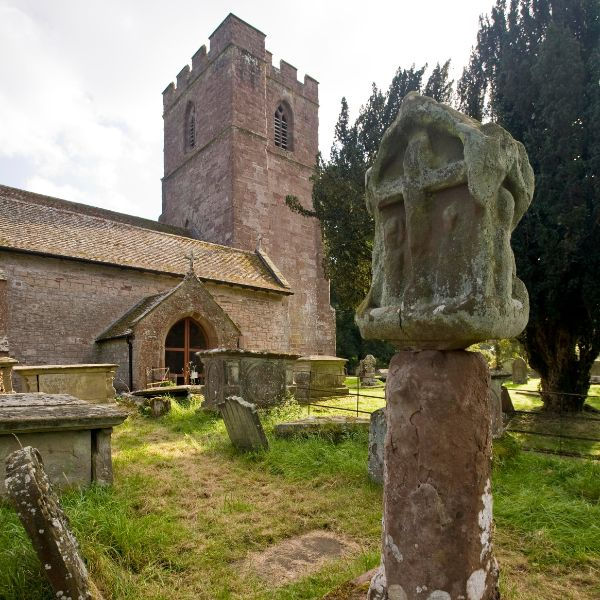
Archenfield is the anglicized form of the ancient Welsh kingdom of Ergyng which embraced the southern and western parts of Herefordshire in England and areas of Powys in east Wales. The present historic district of Archenfield in Herefordshire is considerably smaller than the early British kingdom. Today, Whitchurch is a village in Herefordshire where an old church is dedicated to St. Dyfrig. The first church here was white in color, hence its name. (Archenfield was governed as the Welsh Marches after the Norman Conquest, and only in the sixteenth century did this area became part of Herefordshire and England). At Madley, his birthplace, St Dyfrig also founded a monastery or a church. Nothing remains of the original church, but on its site there stands a Norman church of the Nativity of the Mother of God. The church is richly decorated inside, and among its treasures is a recently restored crypt of the Mother of God where before the Reformation a miracle-working statue of the Holy Virgin stood. Now Madley is a parish and the exact site of the saint’s birth is Chilstone within this parish.

"According to tradition, when St Dyfrig was once preaching on the isle of Ynys Eurddil, an angel appeared before him and instructed him to find a white sow with piglets and to build a monastery in honor of the Holy Trinity on that site. On the following day St Dyfrig, indeed saw a sow in the bushes. The saint fulfilled the will of God and built on that spot a monastery, which was called “Moch-Ross”, that is, “the hogs’ place”. "
The location was perfect for a monastery with woods and an abundant water supply nearby. According to his life, Dyfrig was a man of holiness, wisdom, eloquence, love and prudence. His fame spread all over Wales. Not only the uneducated, but also the learned came to him for instruction.
Later Dyfrig was elevated to the rank of bishop. Unfortunately, history has preserved neither the diocese (or dioceses) he ruled over nor the time of his episcopacy. Tradition holds that the saint’s diocese included at least the entire territory of the Kingdom of Ergyng, which indicates the great authority of this holy man in the region. Later medieval traditions refer to Dyfrig as bishop of Caerleon and even archbishop of the entire Welsh Church. This saint is mentioned in the life of St. Samson of Dol, written around 600 AD. Most likely Dyfrig ordained Samson a deacon, priest, consecrated him a bishop and appointed him abbot of a monastery in the holy island of Caldey off the Pembrokeshire coast. It was said that during the consecration both Sts. Dyfrig and Illtyd saw the Holy Spirit descending on St. Samson in the form of a dove.
Occasionally Dyfrig himself liked to retreat to Caldey for prayer in solitude, especially during the Lenten Fast. Dyfrig was a close friend of such famous saints as Illtyd and Cadoc. Near the monastery of St. Cadoc, St. Dyfrig even built a tiny cell for himself.
The holy well in Hentland, Herefs
The saint of God was famous as a great wonderworker. Wherever he went, he laid his hands on the sick and the possessed, and many people were delivered from their sufferings.
"One day a wealthy man came to Dyfrig, fell on his knees before the saint and with tears implored him to heal his possessed daughter. A demon tormented the poor girl so badly that the relatives had to have her arms and legs tied, otherwise the evil spirit would have forced her to drown herself, or jump in the fire, or bite everyone she met. "
Dyfrig prayed with all his heart to God, St. Peter and all the saints for the girl, and a miracle occurred: The demon left the girl immediately, and she, grateful to the Lord and St. Dyfrig, devoted all her life to the service of the Lord in a convent.
In 545 Dyfrig took part in the Church Synod of Llandewi Brefi along with Sts. David of Mynyw and Deiniol of Bangor. At that Synod he defended the Welsh Church from the heresy of Pelagianism.
The holy hierarch reposed in the Lord on November 14/27 between 546 and 550 (though some researchers give an earlier date of c. 530, and his medieval life gives the year 612, which is chronologically incorrect) on the island of Bardsey in Wales, where he lived as a hermit for the final years of his life. Bardsey in the past was known as “the Rome of Britain” on account of the many ascetics and holy men who lived, prayed and were buried there. For more than fifty years Dyfrig unceasingly labored to spread the Church of Christ and monasticism in various regions of Wales.
On May 23, 1120, the precious relics of St. Dyfrig were translated to Llandaff Cathedral near the Welsh capital of Cardiff. For some time Dyfrig may have served as a bishop in Llandaff. It was related that on the day of the translation of his relics a miracle occurred: after a seven-week drought it started to rain hard. The present Anglican cathedral in Llandaff is dedicated to the Holy Apostles Peter and Paul and to the three Welsh saints—Dubricius (e.g. Dyfrig), Teilo and Oudoceus (Euddogwy). According to tradition, the first Christian settlement here was founded by St. Dyfrig, while Teilo and Oudoceus were his successors. The name “Llandaff” means “church on the river Taff”. A chapel in this cathedral was dedicated to St. Dyfrig, and it is believed that his burial place is in this historic church. (However, St. Teilo who built the first permanent church in this place, is the most venerated saint of the cathedral; his skull relic together with a reliquary are preserved here to this day). Although this magnificent cathedral was heavily damaged during the Second World War, it was splendidly restored. The cathedral has chapels dedicated to such early saints as David, Illtyd, Teilo and Dyfrig.
Dyfrig, one of the principle saints of south Wales, has for many centuries been venerated as a great abbot, bishop and missionary. His influence on contemporary monks and people was great. Many Welsh saints of the sixth century were his students: Sts. Samson and Teilo were among them, as well as Deiniol and Cynfarch (Kingsmark).

Many churches are dedicated to this saint. The church in the quiet village Hentland in Herefordshire is one of them. It is a site of pilgrimages to this day. The foundation of a monastery here is attributed to St. Dyfrig, who was its abbot for seven years and prepared during that time some 2,000 priests. Here he taught theology and the sciences, and students from all over Wales came to his Hentland school: Sts. Samson and Cynfarch may have been among them. The abbey was probably situated on the site of the open field, a little south of the church. In past times Hentland was called Henllan, which means “the old church”, it lies five miles northwest of the town of Ross-on-Wye. The current church is of the thirteenth-fourteenth centuries, while the first church was Celtic. Next to the church is the intact holy well, or spring, of St. Dubricius the water of which formerly not only people, but also animals drank (it has two separate lips for the faithful and for animals). Inside the church there is a stained glass depicting St. Dyfrig with a hedgehog (a symbol of the Kingdom of Ergyng whose name means, “the land of a hedgehog”).
This church is a very warm place with an atmosphere of holiness; it is still heated by a late nineteenth-century cast-iron stove and has several brass oil lamps for lighting. Among its treasures are an old organ and many other things. At the entrance to the church there is a miraculously surviving fourteenth-century cross with carvings on all four sides: those of the Infant Christ and the Virgin Mary (east), the crucified Christ, Holy Theotokos and St. John the Theologian (west), St. Teilo of Wales (south) and St. Dyfrig (north). This cross is a unique one, as most of the crosses were destroyed by Protestants at the time of Cromwell. This parish is one of few in Herefordshire that still observes an old tradition of distributing blessed “pax cakes” on Palm Sunday. These “peace cakes” are a symbol of reconcilement: formerly neighbors from the parish who had quarreled were to break them together with the words “peace and good will” as a part of preparation for the Easter Eucharist.

From ancient times there was a holy well of St. Dyfrig (Ffynnon Ddyfrig) in the spot called Garn Llwyd, one mile away from the main St. Cadoc’s (St. Dyfrig’s friend) Abbey at Llancarfan, in the Vale of Glamorgan. According to tradition, the well was near the little cell which the saint built there for himself. We can also mention the holy well associated with our saint, in Blakemere near Moccas – one of the saint’s two major foundations along with Hentland. On the territory of the Welsh town of Fishguard, Pembrokeshire, there is a place formerly known as Pwll Dyfrig, and today called Glyn-Y-Mel. According to tradition, for some time Dyfrid lived there as recluse in a tiny cell, built by him in a very quiet place, always covered in ivy. It was said that after the repose of St. Dyfrig, a chapel was built there and venerated for many centuries by the local population. A fair in honor of St. Dyfrig was held in this town on the saint’s feast day. Recently during earth works on this site, ancient Christian burials and remains of walls were discovered. A community founded by Dyfrig may have been located there. Part of the fabric of St. Dyfrig’s Chapel can be seen there to this day.
St. Dyfrig is usually depicted with two croziers or with a bishop’s cross, and sometimes with a hedgehog.
Veneration

He is commemorated on the traditional date of 14 November.
Troparion in 1st tone
"Thou art worthily honoured as the Father of Welsh Monasticism. O Hierarch Dyfrig,/ labouring to establish true asceticism with thy brother in the Faith, Samson of Dol/ whom thou didst raise to the dignity of the episcopate./ In thy pastoral love, O Saint,/ pray for us that despite our unspiritual lives/ Christ our God will grant us great mercy."
Hierarch Dyfrig, pray to God for us!
Sources: Orthodoxchristian.com , Wikipedia , celticsaints.org


Comments