
St Hilda, the Venerable Abbess of Whitby
- 6 days ago
- 8 min read
Updated: 3 days ago

St. Hilda (Hild) is one of the most revered female saints in England, widely known as "The Abbess of the English People."
St. Hilda of Whitby was born to nobility in AD 614. She was the second daughter of Hereric, nephew of Edwin, King of Deira, and his wife, Breguswīþ. As a baby, she was orphaned and raised by her uncle, King Edwin. Her uncle then married a charming Christian princess, Ethelburgh of Kent, who was accompanied by monks from her native kingdom, including a well-known ascetic, Paulinus of York.

When Hilda was 13, King Edwin chose to formally convert, and he and his entire court, including Hilda, were baptised as members of his household. York Minster, where they were baptised, is now an ancient cathedral.
Early Life
When Hilda was a baby, her mother had a dream in which she discovered a very precious necklace hidden beneath her garments, which shone brightly throughout England. This dream was realised in her daughter Hilda, who attained tremendous sanctity and became a true light and living example to many religious people. Hilda was baptised by the venerable Bishop Paulinus of York when she was quite young. Her family was related to the pious King Edwin of Northumbria, and she was most likely raised at the royal court of Northumbria during his reign. Without a doubt, she spent the first part of her life with close family.
"The Venerable Bede narrates the story of how, despite tremendous pressure to marry, the beautiful Hilda chose to follow St. Aidan of Lindisfarne following a period of discipleship in Northumbria. She became a nun at the age of 33, and in 647 she entered the Hartlepool monastery (whose name means "a stag by the sea") on the River Tees near Durham."
Mission
St. Hilda immediately became a champion of Iona's Celtic Christianity, standing up to the Roman formalities that were being imported into the area, and her piety and miraculous prayers earned her the attention of many of the Kings of British countries.

She financed and cared for the legendary monk Caedmon, England's first monk-bard. Hilda recognised his spiritual talent of singing angelic songs he heard in dreams and documented them, offering some of the first Christian poetry in the British Isles, aside from St. Patrick's works.

Her spiritual father for many years was the holy Bishop Aidan of Lindisfarne. Hilda visited the kingdom of East Anglia and was about to leave for Gaul to live at the convent of Chelles, but St. Aidan summoned his spiritual daughter back to Northumbria, where he gave her a tiny plot of land on the north bank of the River Wear. Here, the future saint and many other faithful nuns were taught the Irish monastic customs brought to England by St. Aidan. Hilda was soon selected as the second abbess of Hartlepool's double monastery, succeeding St. Hieu. The new abbess organised the life of this community in the tradition of Irish monasteries.
In 655, before facing the massive army of the pagan King Penda of Mercia,

King Oswiu prayed ardently to God and promised that if he won, he would gift estates throughout the kingdom for the establishment of monasteries. A miracle happened: Penda was killed in combat, and his army was crushed. Oswiu kept his pledge and granted twelve properties for the establishment of monastic monasteries. Hilda acquired approximately 1200 acres in the town of Whitby (formerly known as Streneshalc; the contemporary name "Whitby," which means "white town," originated in the eleventh century) in the east of the present-day county of North Yorkshire. In 657, the abbess established a double monastery (with distinct communities for monks and nuns, but all praying in the same church) and began to care for it. The Lord bestowed a bright future on this foundation.

Hilda's lands were lacking the beautiful scenery that other areas enjoyed. The Yorkshire moors surrounded the abbey on one side, while the limitless ocean crashing against the cliffs that protected it on the other. Whitby rose to prominence as a model for monastic life, a great spiritual and intellectual center whose fame spread throughout England and beyond. Whitby saw the development of literature, the arts, spiritual and secular sciences, and different crafts, as well as a strict monastic practice. She sponsored and cared for the famous monk, Caedmon, the first monk-bard of England. It was Hilda who recognized his mystical gift of singing angelic songs he heard in dreams, and wrote them down, providing some of the first Christian poetry in the British Isles besides the works of St. Patrick.
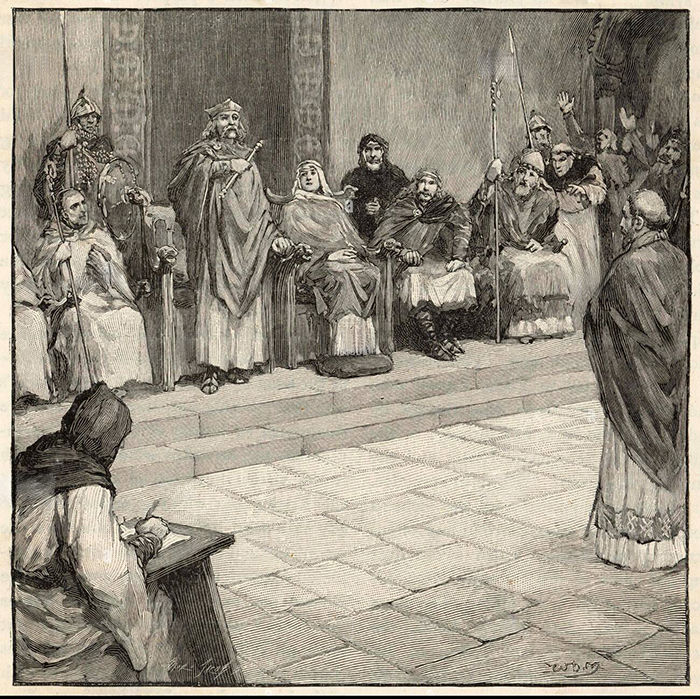
Because of the high renown of St. Hilda's monasticism, the Synod of Whitby was held at her monastery in AD 664, summoned by King Oswig to address the issue of Roman and Celtic Churches celebrating Pascha using different calculations, causing confusion and dissension among believers. The subject was hotly disputed between Bishop Coleman of Northumbria and St. Wilfrid, who had just returned from Rome. After losing the King's support, the Monks of Iona were obliged to relinquish control of Northumbrian monasteries and retire to Ireland, where Celtic Christianity thrived for a few centuries. Following that, those who remained in Northumbria were compelled to accept the Roman dating system, which St. Hilda and all of the sisters did despite their devotion to the older form of Celtic Christianity.
"The Synod of Whitby would prove to be a watershed moment in the history of Celtic Christianity, as the Roman Church would exploit this triumph to assert the Pope's claim to universal jurisdiction and the Roman Church's infallibility. While regrettable, the decision to utilise the Roman Calendar allowed the Church in Northumbria to communicate more effectively with surrounding territories, as well as for Latin education to take root among the Celts."
Eventually, as Europe slid into the Dark Ages and Barbarians destroyed Western civilisation on the continent, the Monks of Northumbria, Iona, Scotia, and Ireland, inheritors of St. Hilda's mixed Celtic-Roman Tradition, would preserve Christianity from illiteracy and re-evangelize most of Northern Europe.
St. Hilda was an able, vigorous, and exceedingly energetic abbess; the most essential duties of the monks and nuns under her care were to extensively study the Holy Scriptures and perform good works. St. Hilda amassed extensive libraries and taught Latin and literature to priests and other clergy members. This saintly woman's wisdom and prudent counsel were so highly valued that kings and bishops sought her assistance. Many Church authorities and scholars, rulers and common people—everyone—held St. Hilda in high regard and considered her a spiritual mentor. Venerable Hilda was adored and cherished as "the mother of her country" because she cared especially for the impoverished and disadvantaged.
"St. Hilda's holy life, authority, popularity, and influence all contributed significantly to the Church's unification and the spread of Christianity in the latter part of seventh-century England. The example of St. Hilda illustrates that monasticism and women's education in early England were of the highest order; "
fact, England produced not only numerous saintly, wise, and gifted abbots and spiritual fathers, but also innumerable abbesses and spiritual moms. Five Whitby-educated monks went on to become bishops, four of whom are honoured as saints: St. John of Beverley, Wonderworker; St. Wilfrid the Younger, Bishop of York; St. Bosa, Bishop of York; and St. Hedda, Bishop of Winchester.

The reputation of Whitby Abbey, "a great monastery, famous for its strict rules and holy life of its monks and nuns, a smithy of saints and a school of future bishops," and its Venerable Abbess Hilda swiftly spread throughout England. St. Hilda was a strong supporter of St. Theodore, the only Greek Archbishop of Canterbury, whose mission was to reconcile the entire English Church and State. According to legend,

"It is said that when St Hilda arrived to bring the light and build her abbey at Whitby, the town was shrouded in shadow, overrun as it was by snakes. These ferocious serpents were known for biting with their deadly venom, which left many in fear for their lives.
Despite the danger, Saint Hilda refused to be intimidated. With her unwavering faith and strong leadership, she turned to prayer and asked for God’s help. As a result of her prayers, a miracle occurred: the snakes were sent tumbling off of the cliffs and turned into stone as they fell! "
We can find information about St Hilda at The History of the English Church and People, written by Venerable Bede of Jarrow.
Her Repose
St. Hilda battled a severe and chronic illness during the last six years of her life. It's possible that it was a fever of shorts. However, her bodily suffering had no effect on the strength of her spirit or her devotion as abbess and counsellor. The saint is reported to have desired to repose at the convent of Hackness (now the village of the same name in North Yorkshire), which she had founded not long before her death—but this was not to be. Hilda passed away peacefully on November 17, 680, at the age of sixty-six, after receiving her final Holy Communion.
"Miracles occurred during the saint's repose. Bells mysteriously began to ring in the monastery of Hackness—just thirteen miles from Whitby—at the same moment when Hilda's pure soul departed her body, and the night before Hilda's repose, a devout nun named Begu saw angels transporting the saint's soul to the heavens. A sister at Whitby Monastery had the same vision. The miracles continued at St. Hilda's relics, and pilgrims were attracted to them for centuries."
St. Hilda was succeeded as Abbess of Whitby by the gifted and wise Abbesses St. Enfleda. Some 25 years after Hilda's death, the synaxarion of St. Gregory the Great (known in the East as Gregory the Dialogist), the Pope of Rome and organiser of the mission to England, was written in Whitby. It should also be noted that the Whitby Monastery was for a long time the primary monastery in Northumbria, was intimately associated with the royal family, and served as the burial ground for the Deira royal family.
Beginning in the late eighth century, the heathen Danes began raiding England's monasteries. In 867, the Whitby monastery was destroyed, but St. Hilda's relics were rescued. It was documented that during Edmund I (939-946), some of her relics were transported to Glastonbury, and some were held at St. Peter's monastery in Gloucester and Durham. The Norman, Roman Catholic monastery of St. Peter and St. Hilda was founded on the same site as St. Hilda's original foundation in 1078. This existed until 1539, when it was dissolved as part of the Reformation. St Hilda was venerated across England, but particularly in the north. There are fifteen historic churches dedicated to her.
Today, pilgrims from various Christian denominations visit Whitby, a small and picturesque town on the North Sea coast, to see the well-preserved Abbey ruins, the ancient church of St. Mary the Virgin, two churches dedicated to St. Hilda (one Anglican and one Catholic), and other churches. Another attraction in Whitby is its famed 199 steps, which are nearly 600 years old. They lead from the "lower part of town" to the east cliff, or "the upper part," which contains the abbey ruins. Most tourists utilise these historic steps to get to the Abbey.
"There is a sweet traditional local legend that seabirds do not soar above the Abbey ruins out of respect for the holy abbess; and even if they do, they slow down each time—in homage of the saint! "
St. Hilda is and has always been revered as the patron saint of education, learning, culture, and poetry. Many countries celebrate Hilda by naming schools and colleges for girls. In England, the Colleges of St. Bede and St. Hilda in Durham and St. Hilda's College in Oxford are named in her honor. Churches dedicated to St. Hilda can be found throughout the United States and Canada. "Hilda" remains a baptismal name for girls in England and Germany. According to tradition, St. Hilda's head is still kept in Durham Cathedral today.
Holy Abbess Hilda, pray to God for us!
Commemorated November 17 (repose) and August 25(translation of relics)

Troparion, in Tone I -
"Though thou wast of royal birth and lineage, O Hilda, thou didst spurn earthly riches and the allurements of the flesh. And cleaving with all thy heart unto Christ, thou didst take up the struggle of the monastic life. Wherefore, God endowed thee with such wisdom and prudence that all the people hastened unto thee for counsel and succour. O venerable one, entreat Him unceasingly, that He grant us great mercy."


Comments