
St Alfred "The Great", King of Wessex
- Aug 4
- 18 min read
Updated: 13 hours ago

"Why are we here in our Church today? There are perhaps many reasons but most basically in hope of salvation, to worship God in Orthodox Christian Tradition, and to help spread His Gospel in Orthodoxy to our neighbors. A secondary historical reason in the life of the Church is because Christianity came to the British Isles and baptized the English language, which, brought to these shores, enables us to bring the Orthodox Gospel to our English-speaking neighbors in Appalachian America today.
One important figure in that, unknown to me in my childhood, is St. Alfred the Great of England. I became dimly aware of him as an historical figure, a king, because my birth name was Alfred, which had been off and on in my family for generations. But I was not aware growing up that he was a saint and a figure most important for his Christian leadership of what became England. In fact, he is regarded as the father of the English nation, kind of like an ancient George Washington, who, however, was an Orthodox Christian...." Homily from St. John’s Russian Orthodox Mission Church in Winfield, PA, for the Fourth Sunday of Lent, the Sunday of St. John of the Ladder, by Priest Paul.

"Alfred found learning dead and he restored it. Education neglected and he revived it. The laws powerless, and he gave them force. The Church debased, and he raised it. The land ravaged by a fearful enemy, from which he delivered it. Alfred's name will live as long as mankind shall respect the past." -Inscription on the Statue to Alfred the Great in Wantage"
His Life

At the time of Alfred`s birth, it seemed likely that Christianity and civilization would be stamped out in these lands by the pagan Danish Vikings; and a state of panic prevailed on all sides, while in England conditions were not improved by the fact the Alfred`s father, Aethelwulf, King of the West Saxons (Wessex), the most important monarch in the island, was a mild and pious personage who seems to have been much more anxious to keep himself in the good graces of the Church than to use his sword against the invaders.

Alfred was born in 849 at Wantage in the Vale of the White Horse in Berkshire; He was Aethelwulf`s youngest son, his mother being Queen Osburgh, daughter of Oslac, a nobleman who was by descent a Jute from the isle of Wight; but the boy was his father's favourite.
"Aethelwulf was a devout Christian, a trait that would reflect in Alfred's life. It was during his youth that Bishop Asser tells the story of how as a child Alfred won a prize of a volume of poetry in English offered by his mother to the first of her children able to memorize it."
Aethelwurf himself paid a visit to Rome, and at the age of four Alfred was sent to Rome, where, as a compliment to his family, he was invested with the name and insignia of a Roman consul. In 855 A.D., ; There the King made magnificent presents to the ecclesiastical authorities, including gold and silver in money, a crown weighing four pounds of pure gold, two gold vases, a gold-mounted sword, two gold statues, and other valuable articles, all revealing the wealth of the Kingdom of Wessex. In fact, in spite of the Viking plunderers, he was so rich that in that same year he made over to the church in England one-tenth of his estates.
While still on the Continent Althelwulf received news of the death of Queen Osburh, and shortly afterwards he married Princess Judith, the very young daughter of King Charles the Bald of France. He survived his return to England with his child-wife for only two years, and was succeeded by his eldest son Aethelbald, who, actually, had seized the throne during his father`s absence abroad, but had been forgiven by his mild and pious parent, and now added to his crimes by falling love with the Princess Judith.
"Legend also has it that the young Alfred spent time in Ireland seeking healing. He was troubled by health problems throughout his life although today he is often portrayed as a great warrior who was noted more for his intellect."
Alfred & the Viking Wars
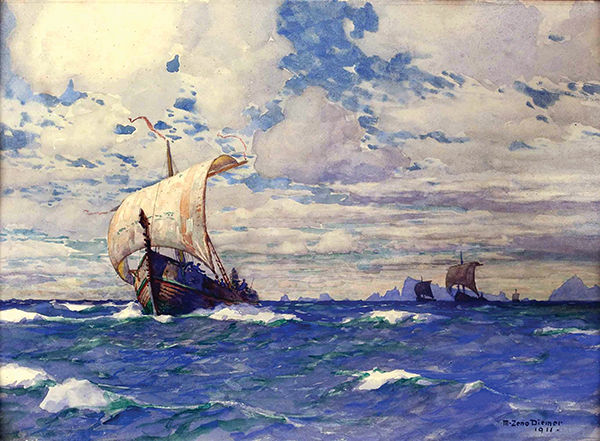
By the time of St Alfred's birth, seaborne raids against the Saxon lands of England had been going on for some 60 years. Split into several separate and competing monarchies, the Saxons struggled to repel the raiders sailing in from the North Sea. Usually called “Vikings” today, 9th century chroniclers called the invaders Danes, pagans, heathens, or pirates. Most of the men attacking the British Isles came from what is now Denmark and Norway.
Abandoned by the Romans in the early 5th century, Britain fell to invading Angles, Saxons, and Jutes. Soldiers from these Germanic tribes from northern Europe had been invited as mercenaries by the late Romans. More and more arrived, and pushed aside or absorbed the native Britons to take over most of what is now England. These Germanic Britons were later referred to as the Anglo-Saxons.
"For six years, “the Great Army” of Viking raiders had roamed nearly at will across the Saxon kingdoms of England. Towns, villages, monasteries and convents had all been captured and destroyed, their inhabitants slaughtered. Most of Saxon England had fallen and tottered on the edge of ruin. Alfred’s brother, King Aethelred, ruled the last lands able to offer any resistance to the Vikings."

Between 793 and 851 A.D., the terrible Vikings had sacked cities such as Utrecht, Antwerp, Hamberg and Bordeaux on the Continent, and London, Canterbury, Rochester, and many others in England; how they had looted monasteries and churches far and wide, carrying off enormous spoil; and how large areas in the north of the European continent, all Ireland, and a considerable part of Britain, had been utterly wasted by them.
They were sailing up the Bristol Channel, or the Estuary of the Dee, devastating Shropshire, while at about the same time we find other bands of them plundering Spain and the Barbary Coast.
In 860 A.D., they sacked and burnt Winchester, though the parent-church of the present cathedral, which had just been fortified by Bishop Swithun, escaped; but while they were marching off with the plunder they were attacked and almost annihilated by the men of Hampshire and Berkshire, who recovered the stolen goods.
"Aethelbald was succeeded in turn by his two brothers, Aethbert and Aethelred, and both had to fight against the Danish Vikings; but it was in 866 A.D., in the reign of the latter, that the most serious invasion of the country began. The Vikings had now formed themselves into what was known as the “Grand Army,” a vast assembly of cavalry and infantry; and the brunt of the first attack was borne by Northumbria, whose two joint kings were killed while fighting the enemy in the streets of York."

Thenceforth the north-east coasts of Britain were largely settled by these Danes, and their blood still runs in the veins of many an Englishman of those parts.
In 868 A.D., the Grand Army captured Nottingham but were afterwards themselves besieged there by King Aethelred`s forces from Wessex, amd having come to terms with him, marched back to York. At this time Alfred, who fought beside his brother, the King, at Nottingham was 18 years of age, and had just married Ealhswith, daughter of Aethelred, surnamed the Mickle, Ealderman of the Gainas, a people whose name survives in Gainsborough, Lincolnshire. This Mercian lady, however, plays no part whatsoever in the drama of her time, and either was of too extraordinary a character to contribute anything elevating to the historians, or else was of too ordinary a disposition to contribute anything at all! But she was the mother of some extradinary children of which nothing could be done without them, and their mother who bore them! Why her husband King Alfred held her in such high esteem.
In 870 A.D., the Viking army marched southwards, burning Peterborough, Ely, and other places; but at Snareshill, near Thetford, in Norfolk, they were met by the East Anglians under the King Edmund, a vassal of Wessex, afterwards canonized as a saint and martyr. The invaders were victorious, and Edmund having been captured, was tied to a tree and shot to death with arrows. On the heath near Snareshill you may see several mounds which are believed to be the graves of the men who fell in this battle; but Edmund`s body was taken in the end to his palace of Bedricsworth, the name of which place was on that account changed to Bury (i.e. Burgh) St. Edmund`s, where the famous abbey was afterwards erected over his tomb.
The Grand Army wintered at Thetford, and in the spring of 871 A.D., marched against Wessex, capturing on their way the city of Reading, an important Anglo-Saxon centre, where many graves of the period have been found. A few days later the royal army of Wessex, under the King and his young brother Alfred, arrived on the scene.
The young Prince had yet to make his mark on the battlefield and grew impatient waiting for his brother to arrive. Giving way to his impetuous nature, the Alfred ordered his men into battle, leading them against the vast army led by two infamous Viking kings—and, as it turned out, into the pages of British history.
"Here, at that part of the Downs known as Ashdown, Alfred led an attack on them; “charging up hill like a wild boar”; and when his forces had been joined by those of his brother, the Vikings fled back to Reading, leaving their King, five of his generals, and thousands of men, dead upon the Downs. There is a sword in the British Museum which was found at Ashdown, and which is probably a relic of this battle. This great success, however, was followed by almost as great a defeat; for shortly afterwards the reinforced Viking army was victorious at Marden, near Bedwyn in Wiltshire, and King Aethelred was mortally wounded. He died a few days later and was buried at Wimborne in Dorset (where, however, there vare now no remains of the period) and Alfred, then aged 22, was crowned in his stead; but within a month of his coronation he was badly defeated in a fierce engagement at Wilton in Wiltshire."

The Viking army marched again against Alfred and his Kingdom of Wessex, and so great was their concentration on this objective that no raids elsewhere in Britain or on the Continent are recorded at this time. Alfred, in fact, had to meet the entire Viking power; and his ultimate victory over them can truly be said to have saved western Christendom.
The Grand Army got as far as Wareham in Dorset, but here they were besieged by Alfred. The Viking cavalry, however, burst out of the town and rode to Exeter, where again they were besieged; and meanwhile a storm wrecked the invaders` fleet as it was passing under the cliffs of Swanage, and 120 ships were sunk, all of the crews being drowned. A truce was called, and the Vikings retired to Gloucester; but in 878 A.D., they broke the pact and again marched into Wessex, seizing Chippenham in Wiltshire, and makin it the base of a campaign which, by its swiftness and unexpectedness, threw the whole kingdom into panic.
Alfred and his chief nobles fled to Athelney in Somerset, then an island in the marshes of the Parret, and there amongst the reeds and osiers they lived for some months.
The tide of the Vikings` success in this campaign turned when a considerable body of them was nearly annihilated in Devonshire, at the Iron Age fort overlooking Lynmouth, the Devonshire fyrd had been fled to the fort, but unexpectedly burst out to defeat the Vikings who had sailed over from South Wales, so to create a pincer movement with the Vikings in Chippenham, this crucial victory allowed Alfred to leave Athelney and meet his troops at Penselwood in Somerset, and marched to Iley near Warminster in Wiltshire where he formed up his army ready to meet the Vikings. He lead his army to Ethandum, probably Eddington, whither the Viking Grand Army had advanced from Chippenham to meet him.
The battle was a complete victory for Alfred, and the remnant of the Danes, under their king Guthrum, fled back to their base, leaving hecatombs of dead behind them.
A few days later Guthrum surrendered on terms.
"Among the terms of the surrender was that Guthrum converted to Christianity. Three weeks later King Guthrum and 29 of his chief men were baptized at Alfred's court at Aller, near Atheiney, with Alfred receiving Guthrum as his spiritual son with the name Athelstan. In the treaty negotiated in either 879 or 880 Alfred and Guthrum established the borders dividing their lands of which that part controlled by Guthrum became known as Danelaw. While the treaty with Guthrum brought an end to large scale conflicts, Alfred still had to deal with raids and incursions. During this period, Arthur reoccupied the city of London and initiated a program of restoring the city."

The magnanimous Alfred, in whom we can already recognise the typical English gentleman, then entertained the fallen Vikings sumptuously for some three weeks at Isle of Wedmore where Alfred had a palace, after which they were permitted to return to Chippenham, whence they marched their men to Cirencester, and so back to East Anglia.
It will be remembered that in 870 A.D., the Vikings had murdered Edmund, the East Anglian King, whose body was afterwards buried at Bury St. Edmund`s; and now, only ten years or so later, we find the converted Guthrum amongst the pilgrims at his tomb, and in the British Museum you may see coins struck by him in honour of this royal English martyr, who for many is the patron saint of England, as he died for our Christian faith and for England.
With the death of Guthrum in 889, a political vacuum was created in which revived attacks by Danes from the continent reopened war with the Vikings, thus ending these quiet years of Arthur's life. Against the traditionally organized Danish tactics Arthur counter with a restructured military organization that included a standing, mobile field army, a network of garrisons, and a small fleet of ships navigating the rivers and estuaries. Alfred's re-organization of the military defense system included the establishment of network of fortresses at strategic points in the kingdom. These burhs (later called boroughs) enabled his army to confront Viking attacks anywhere in the kingdom within a day, which formed significant obstacles to the Viking invaders.
Alfred & the Church
"Always the deep thinker, Alfred considered that the source of all the problems of England was not political, civil and military, but spiritual and moral. He believed that the heathen invasions had happened because of Christian England's spiritual decline during the late eighth and ninth centuries. "
The heathen men had come as a punishment for English decadence and unworthiness, ignorance and materialism. Alfred therefore struck at the heart of the problem and instituted a rebirth of religion and learning, which was to be enshrined in the revival of monasticism, culture and the law. Only this spiritual rebirth and cultural renaissance could ensure peace, respect for authority, morality and prosperity in the future.
Just as he had saved Christian England militarily, Alfred now set about saving English Christendom through piety and learning. Thus Alfred personally directed and set an example for the affairs of his Kingdom. He went to the divine services and the communion service every day. He took part in the reading of certain psalms and prayers in the daytime and at night. He listened while the Scriptures and other books were read aloud and learned by heart. Later he was to begin a translation of the psalms, which survives. He continued his habits of almsgiving and charity to the poor and showed immense generosity and hospitality to native people and foreign visitors. He cherished his bishops and clergy, his nobles and servants.

Alfred especially regretted the lack of divine learning and knowledge. The extraordinary ignorance of Latin among clergy is well-known. Indeed the Popes of the period, John VIII and Formosus, all justly reproached the English Church for its decadence.
"In this respect Alfred resembled King Solomon of old who came to despise the things of this world and sought for the Wisdom of God. The Lord heard Alfred's prayer and supplied him with learned men. From Mercia in the early 880s there came the learned Bishop Werferth of Worcester who translated the Dialogues of St Gregory the Great into English. Then also from Mercia there came Plegmund, later to be Archbishop of Canterbury and to be venerated as a saint, and also the priests Athelstan and Werwulf. Spending time with these four constantly, Alfred later sought new instructors from overseas."
Showing great curiosity in the acquisition of new religious knowledge, Alfred wished to restore learning in general. He set an example by personally learning Latin over a period of about five years between 887 and 892. This began on St Martin's Day, 11 November 887. Then aged thirty-nine, Alfred was beginning an apprenticeship. As we shall see, eventually aided by his scholars, he was to become a translator from Latin into English of essential works from the early Church for the benefit of the faithful. This idea started from Alfred's handbook of quotations, which he had kept from his youth.
Alfred also gave instructions to the sons of the people who spent time with the King, loving them no less than his own children. Of this he later wrote in his foreword to 'Pastoral Care': 'Let all the free-born youth now in England and who are able be set to learning'. The importance of his cathedral-schools he set up for this purpose should not be underestimated in shaping the next generation of the English elite.
"Alfred encouraged craftsmen who designed new treasures and paid much attention to the adornment of churches with gold and silver. Alfred was also, it seems, something of a church architect. He began a program of building in stone, importing builders and craftsmen from Europe."
One historian of church architecture, E. A. Fisher, has pointed out that the result was a new beginning in English church architecture. Although based on European motifs, it was by no means a copy of a foreign style, but a truly national development, which continued right until the Norman Conquest.
There was contact too with the Papacy and in 883 Pope Marinus I sent him a splinter of the True Cross. Throughout that period Alfred sent alms to Rome virtually every year. Later, from about 885, relations started to become strained as Rome and the Papacy declined into political chaos and decadence. At this time Alfred was also in written contact with the Church further afield too. Thus he was in contact with Patriarch Elias III of Jerusalem who sent Alfred gifts. It is recorded that Alfred sent alms to both Patriarch Elias and 'to India'. This may have meant Syria, but could actually mean even further east.
Alfred & the Rebirth of Monastic Life
By appointing pious, learned, and trustworthy bishops and abbots, Albert initiated a spiritual revival among the monasteries. He also emphasized translation of books he deemed "most necessary for all men to know." He himself contributed to the spiritual revival through his translations that included translation into English of Gregory the Great's Pastoral Care , Boethius' Consolation of Philosophy, St. Augustine's Soliloquies, and the first fifty psalms of the Psalter.
"In thanksgiving for his victory planned on the isle of Athelney, from where England had been saved, Alfred built his first monastery. Linked by a bridge with two towers to the mainland, it was square in plan with four rounded arches. It appears to have followed the plan of a Greek cross and was inspired perhaps by the church at Germigny on the Loire in France."

Here Alfred brought artists and craftsmen from overseas and gathered priests, deacons and monks of several nationalities, so that his own people could relearn the traditions of monastic life. Although his attempt to restore monastic life was to be unsuccessful here, it was at least to sow great seeds for the future.
From the far north of France, in about 886 there came the elderly but learned priest, Grimbald, and then from Saxony the priest John who became Abbot of Athelney. Both John and Grimbald were later esteemed to be saints. Other clergy also came from France, and even one convert from among the Vikings. At that time, in about 887, there also appeared the priest, or possibly bishop, Asser, from St David's in Wales, under whose name was written an unfinished life of King Alfred. This life survives to this day and regardless of when, where and by whom the version with its interpolations which we now have, was actually written, it is one of the main sources for the life of Alfred.
Alfred's second foundation, a convent, begun in 880, was established at Shaftesbury. It was here that his own daughter, Ethelgifu, became Abbess. Many other noble nuns lived with her. Alfred endowed both monasteries, and many others already existing, abundantly. In his love for the English character and English life, his vision and his care were to restore Christian England to something of the glory that she had held before the heathen wars.
Alfred also planned two more foundations, a monastery and a convent, in the main city of Wessex Christendom, Winchester. Although these were not to be completed until after his death, Alfred was to be buried and for over 500 years honoured in Winchester, and his widow was to retire to the convent, the Nunnaminster. Such facts make the much later medieval accusation that Alfred 'despoiled' the monastery of Abingdon sound strange indeed.
Such was Alfred's faith that he resolved to devote to God one half of his service, both by day and by night, and one half of his riches. His time was measured accurately by a candle, which burned inside an ox-horn lantern, so that he actually consecrated exactly half of all his energies to God.
Alfred the Lawgiver

Between 890 and 893 Alfred drew up a great law-code, which has led many to give him the title, 'Alfred the Lawgiver'. He wished to restore the rule of law, enforcing justice, wherever law and order had broken down because of the heathen invasions and the breakdown of church and monastic life.
His laws were based on the Ten Commandments of Hebrew Mosaic Law, on the best of the traditional English laws of Kent, Mercia and Wessex, and on Roman government.
"Much was based on the Ten Commandments, given to Moses, fulfilled and interpreted by the love and compassion of Christ, continued by the teachings of the Apostles and handed down through the ordinances of the Church Councils down the ages. In it Alfred emphasised the importance of the Golden Rule of St Matthew (Matt 7, 12): 'Do as ye would be done by', which he enshrined in his laws as: 'Judge as ye would be judged'."
Alfred's laws, drawn up by consulting councillors from the whole Kingdom and based on previous laws of other kingdoms, were designed to draw all English people together, building up their common identity. They stressed the sacredness of a man's oath and the faith he owed to his lord and the King. Alfred limited the use of the death penalty and physical punishments and tried to stop blood-feuds. Physical punishments were to a large degree replaced by fines and the ability to prove one's innocence before God and man. And it was no light matter to destroy God's handiwork through use of the death penalty.
Written in Old English, so that all could understand, his laws set out the punishments for all manner of crime, from murder to theft and injury to sacrilege. Crimes were tried by monthly 'folk-moots', or local courts under the supervision of the king's reeve or local representative. The reeves, the judges and other officials had to be instructed too and Alfred was very strict on this. One rule, said Alfred, applied everywhere: 'Judge not one judgement for the rich, and another for the poor'. Such were the foundations of English justice that he laid.
His laws also emphasized the importance of keeping the Church's feasts and fasts. For example, it set forth the keeping of Holy Week and Easter Week, the twelve days of Christmas, the Dormition of the Mother of God on 15 August, the Feast of the Apostles Peter and Paul on 29 June, the Feast of the Apostle of the English, St Gregory the Great, on 12 March. Those who failed to keep Great Lent were to be fined. Alfred was seen to be a just and painstaking judge who loved the pursuit of wisdom and took special care of the poor. There were two things that he abhorred in particular. These were ignorance and laziness. Despite his illness, sustained by the help of God, Alfred continually set an example to others, encouraging, instructing, urging, chastising, showing special concern for education and books, tirelessly toiling to rebuild Christian England.
His Repose
Alfred married Ealhswith in 868. She was the daughter of a Mercian nobleman, Aethelred Mucil the Ealdorman of the Gaini. Their children included Edward the Elder, who succeeded Arthur as king, Aetheflaed, who became Queen of Mercia, and Aelfthryth, who married Count Baldwin II of Flanders.
"Alfred died on October 26, most probably in 899. The cause of his death is unknown, but may be from Crohn's disease, as he suffered throughout his life with a painful and unpleasant illness. "
His body was temporarily buried in the Old Minster in Winchester before being moved to the New Minster. In 1110, his relics were translated to Hyde Abbey along with those of his wife and children. After the dissolution of the abbey during the reign of Henry VIII in 1539, the church was demolished, but leaving the graves intact. In 1788, when a prison was being constructed by convicts on the site of the royal graves, and many others, they were probably rediscovered by chance. But, the coffins were stripped of lead, bones were scattered and lost, and subsequently no identifiable remains of Alfred have been found.

Feast Day: November 8, 2024 / October 26
Troparion
Troparion, Tone IV:
"Hearkening to the White Christ, thou camest forth from thy flood-girt fastness to overcome the heathen and lead them forth to holy baptism.
Thou didst build churches, strongholds, shires and swift ships, restoring the law of God and making thyself beloved of all.
O wise King and glory of free England, who reignest in the Winchester of the heavenly England, thou who didst vanquish heathendom by Christendom, establish anew the Orthodox Faith in thy land that we may glorify God, Who alone made thee great."


Comments